Elevating Airport Operations with Indoor LED Video Wall Technology
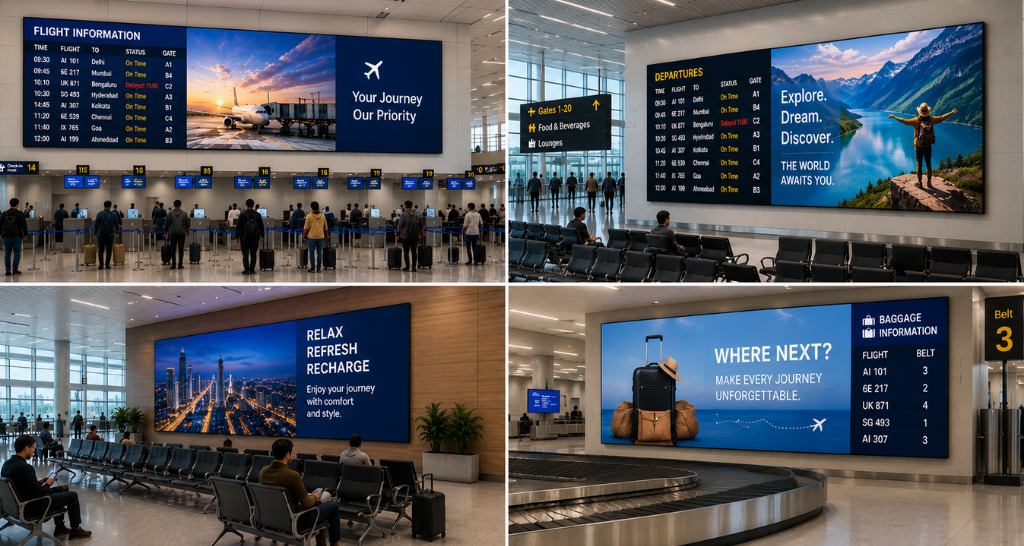
Imagine walking into an airport terminal thousands of passengers rushing past, departure boards flashing updates, gate changes announced every few minutes, and queues snaking through security. Now imagine all of that chaos being guided, streamlined, and transformed into a smooth visual experience by a single powerful technology. That technology is the Indoor LED Video Wall. From Delhi’s Indira Gandhi International Airport to hubs across Mumbai, Bengaluru, and Hyderabad, airports across India are rapidly adopting Indoor LED Video Wall Technology to future-proof their operations and elevate the passenger journey. But what exactly makes this technology so transformative for the aviation sector?
What Is an Indoor LED Video Wall and Why Do Airports Need It?
An Indoor LED Video Wall is a large-format display system built from modular LED panels that seamlessly tile together to form a single, high-resolution visual canvas. Unlike conventional screens or LCD panels, LED video walls offer superior brightness, unmatched clarity at distance, and near-zero downtime all critical requirements in an airport environment that operates 24 hours a day, 365 days a year.
Airports are among the world’s most information-dense environments. Passengers need real-time flight status, gate directions, baggage carousel assignments, and emergency communications often simultaneously, in multiple languages. Traditional static signage and dated LCD boards simply cannot scale to meet these demands. The Indoor LED Video Wall addresses every one of these gaps with dynamic, real-time, and remotely manageable content delivery.
Delhi’s Indira Gandhi International Airport (IGIA), which handled over 79.2 million passengers in FY 2024–25, making it the ninth-busiest airport globally, is a prime example of why scalable visual communication infrastructure is non-negotiable. At this scale, an Indoor LED Video Wall is not a luxury it is operational infrastructure.
Key Applications of Indoor LED Video Wall for Airports
The deployment of an Indoor LED video wall for airports spans multiple operational zones, each with distinct communication needs:
1. Departure & Arrival Halls Real-Time Flight Information
The most visible application of an Airport LED video wall is as a centralized Flight Information Display System (FIDS). Positioned in departure halls and arrival concourses, these walls display live flight schedules, gate assignments, boarding status, and delay alerts. Unlike traditional flip-boards or small LCD panels, an Indoor LED Video Wall can be read clearly from across a vast terminal even in busy, well-lit environments thanks to high-brightness LED modules with pixel pitches as fine as P1.2 to P2.5.
Airports in Delhi and other major Indian cities are leveraging these displays to accommodate multilingual content, showing flight updates in Hindi, English, and regional languages simultaneously a critical feature for a country as linguistically diverse as India.
2. Security & Check-In Zones Wayfinding and Queue Management
Long queues at security checkpoints are one of the most persistent pain points in airport operations. Deploying an Indoor LED Video Wall at check-in counters and security lanes allows airports to dynamically display queue status, lane availability, and real-time wait time estimates. This actively redistributes passenger flow, reducing bottlenecks and improving throughput a direct operational benefit backed by Indoor LED Video Wall Technology.
3. Baggage Claim Areas Reducing Passenger Anxiety
Post-flight, passengers are eager to collect their luggage and exit. Clear, large-format LED display for airport operations in baggage claim halls displays belt assignments, estimated delivery times, and carousel numbers information that significantly reduces confusion and unnecessary crowding. The Indoor LED Video Wall here acts as a silent ground staff member, guiding thousands of passengers simultaneously without any additional manpower.
4. Control Rooms Operational Command & Monitoring
Behind the scenes, airport control rooms are the nerve centres of all ground operations. Fine-pitch Indoor LED Video Wall Technology enables controllers to view multiple data feeds aircraft tracking, runway status, ground service equipment movement, and weather data on a single, seamless display wall. Delhi International Airport Limited (DIAL) has already integrated AI-powered systems into its airside management; pairing these with a high-resolution Indoor LED Video Wall gives operators unprecedented visual command of complex, multi-source data.
How Does Indoor LED Video Wall Technology Improve Passenger Experience?
Indoor LED Video Wall Technology improves the passenger experience in airports by providing real-time, high-visibility information that reduces confusion, minimises dwell-time anxiety, and creates an immersive terminal environment. Studies consistently show that passengers who feel informed are less stressed and report higher satisfaction scores.
Beyond pure information delivery, an Airport LED video wall can transform sterile terminal interiors into engaging visual environments. Airports can display destination reels, cultural showcases, and brand campaigns that entertain passengers during layovers. This dual purpose functional and experiential makes the Indoor LED Video Wall one of the most versatile investments in modern airport infrastructure.
For a city like Delhi, which serves passengers from over 150 airports worldwide across more than 60 airlines, the ability to deliver consistent, instant, and visually impactful communication across sprawling terminal areas T1, T2, and T3 is made practical and scalable only through Indoor LED Video Wall deployments.
Advertising Revenue: The Business Case for Airport LED Video Wall
An often-underappreciated benefit of deploying an Indoor LED video wall for airports is the significant advertising revenue it enables. Airports attract a captive, high-income audience frequent flyers, business travellers, international tourists making them premium advertising real estate for luxury brands, airlines, financial services, and consumer goods companies.
The dynamic, software-managed nature of an Airport LED video wall means advertising content can be scheduled, rotated, and targeted by time of day, flight destination, or passenger demographics. A single Indoor LED Video Wall installation can cycle between flight information, brand campaigns, and public service announcements all managed remotely through a central content management system. This flexibility maximises revenue yield from every square foot of display space.
What to Look for When Choosing an Indoor LED Video Wall for Airports?
Selecting the right LED display for airport operations involves evaluating several technical and operational parameters:
Pixel Pitch: Fine-pitch panels (P1.2–P2.5) are ideal for close-range viewing in control rooms and check-in zones. Larger pitches (P3–P4) suit departure halls with greater viewing distances.
Brightness & Contrast: Airport terminals have varied lighting sunlit atriums, artificially lit concourses. The Indoor LED Video Wall must maintain legibility across all conditions, typically requiring 800–1500 nits of brightness indoors.
Reliability & Redundancy: Airport displays must achieve near-100% uptime. Modular design, front-access maintenance, and hot-swappable components are non-negotiable features for any Indoor LED Video Wall Technology deployed in critical aviation environments.
Scalability: Airports grow and so should their display infrastructure. Modular Indoor LED video wall for airports solutions allow phased expansion without replacing entire installations.
Integration Capability: The best LED display for airport operations integrates natively with existing FIDS, airport management software, and content scheduling systems via standard APIs and control protocols.
Indoor LED Video Wall vs. Traditional Display Technologies in Airports
When compared directly to LCD video walls, projection systems, or legacy flip-board displays, the Airport LED video wall consistently outperforms across every key metric. LED panels are thinner, lighter, and more energy-efficient than LCD alternatives. They carry no bezels to interrupt the visual field, creating a truly seamless display surface. Their operational life exceeds 100,000 hours roughly 11 years of continuous use making them the most cost-effective long-term investment for airport infrastructure planners.
Furthermore, Indoor LED Video Wall Technology supports custom shapes and curved configurations, allowing architects to integrate displays into airport interiors as design features rather than afterthoughts transforming terminals in cities like Delhi, Chennai, and Kolkata into world-class visual experiences, AV solutions deliver seamless audio, video, and control integration to improve communication, collaboration, presentations, and user experiences.
.