“The Screen Is Too Blurry” Problem: Why Campuses & Universities Are Upgrading to LED Video Walls
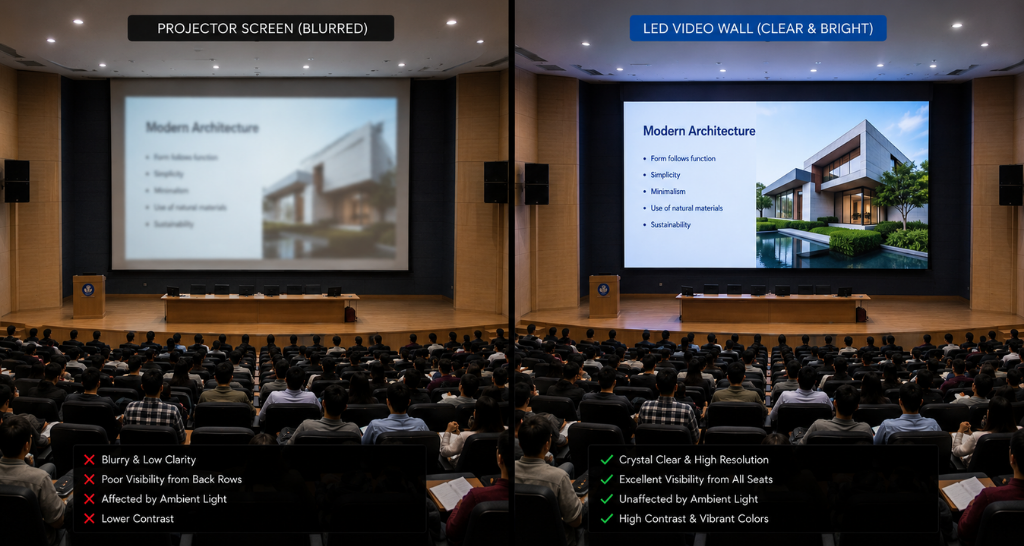
It was just another Tuesday morning. A packed lecture hall, a professor explaining something important on the Screen, and somewhere in the middle rows a student squinting. Not because of bad eyesight. Not because they were distracted. But because the screen at the front of the room looked like a blurred photocopy of what it was supposed to show. The text was there, technically. The diagram existed, somewhere in that washed-out rectangle of light. But reading it felt like work the kind of work that has nothing to do with actually learning the subject. That student closed their notebook halfway through the lecture. Not out of disrespect. Simply because there was nothing clear enough to write down.
This is exactly why many campuses and universities are now moving toward LED Video Walls, delivering sharper visuals, better visibility, and a learning experience where students can focus on understanding concepts instead of struggling to see them.
This is not one story. This is happening in lecture halls across campuses every single day and it is a problem that rarely gets spoken about directly.
So What Exactly Is the Display Problem Nobody Talks About?
Most universities have been running the same projector-based setup for years. The projector gets installed, everyone assumes the job is done, and the slow decay begins quietly. Bulbs lose brightness. Colours shift. Resolution that once seemed acceptable now struggles to display fine print, detailed diagrams, or anything with small text at a readable size.
The issue is not just technical, it is deeply practical. A student sitting ten rows back in a lecture hall is not being lazy when they cannot read the screen. They are sitting in a room where the display technology has simply not kept pace with what education demands. And because the problem builds gradually, it rarely triggers an urgent response. The projector still works. It just does not work well enough and LED Video Walls provide crystal-clear visuals and vibrant colors, improving visibility in classrooms and lecture halls..
And that gap between “working” and “working well enough” is where student attention, engagement, and learning quietly slips away.
Why Do Projectors Keep Failing in Lecture Halls?
Understanding why projectors fail is important because it explains why the problem keeps returning no matter how many times the maintenance team fixes things.
Projector bulbs are rated for a limited number of hours and begin losing brightness almost immediately after installation. By the time a bulb reaches 1,000 hours of use which is roughly one academic semester in a busy lecture hall it may already be operating at half its original brightness. No alarm goes off. No error message appears. The screen just gets a little dimmer, a little harder to read, a little more invisible to anyone sitting beyond the third row and Modern LED Video Walls ensure every student gets a clear view, even from the last row of large auditoriums.
On top of that, projectors are completely defeated by ambient light. Open a window, switch on the room lights, or let a little afternoon sun through the curtains and the projected image becomes a ghost of itself. Lecture halls are not designed to be dark rooms. They are designed for people to sit, write, and think. Forcing students into a dim environment just to make a screen visible is a compromise that costs more than most administrators realise.
Then there is the resolution problem. Modern academic content engineering schematics, medical imaging, architectural drawings, data visualisations requires a level of display clarity that most projectors simply cannot deliver at the sizes needed for a lecture hall. What looks acceptable on a laptop screen becomes unreadable when blown up to fill a large wall,
What Does a Lecture Hall Display Actually Need to Do?
Before choosing a solution, it helps to be clear about the real requirements not from a technical specification sheet, but from the perspective of the people using the room every day.
Every student in the room needs to see the same thing clearly whether they are in the front row or the back corner. The display needs to work whether the room lights are on or off. It needs to show fine text, detailed diagrams, and accurate colours without any loss of quality. It needs to work consistently across every class, every day, without teachers having to adjust settings or maintenance teams having to intervene regularly and Universities use LED Video Walls to create immersive learning experiences with sharp and dynamic content and LED Video Walls deliver seamless large-screen performance, making presentations more impactful and visually engaging.
It needs to be invisible in the best possible sense technology that simply works, so that the classroom can focus entirely on education.
This Is Exactly Why Campuses Are Moving to LED Video Walls
LED Video Walls are not a premium upgrade for elite institutions. They are a practical, long-term solution to a problem that projectors were never fully equipped to solve.
Unlike projectors, LED Video Walls generate their own light at the pixel level. There is no single bulb fading over time, no beam being projected across a distance and losing intensity along the way. Every part of the screen is equally bright, equally sharp, and equally visible from any seat in the room, under any lighting condition and LED Video Walls reduce visibility issues caused by ambient light and enhance audience engagement.
For a LED Video Wall for colleges, this means the display works the same on a cloudy morning as it does in a fully lit afternoon session. The professor does not need to close the blinds. Students do not need to strain. The content is simply there clear, accurate, and readable for everyone in the room.
And because LED panels have a lifespan measured in tens of thousands of hours with no consumable parts, the ongoing cost is dramatically lower than the cycle of projector bulb replacements, alignment fixes, and filter cleaning that most campus maintenance teams deal with every semester.
What Changes When the Display Actually Works Properly?
The shift is immediate and it shows up in ways that go beyond the screen itself.
When students can see everything clearly every label on a diagram, every data point on a chart, every word in a case study they stop spending mental energy on decoding the screen and start spending it on understanding the content. That is a fundamental shift in how a classroom functions. The cognitive load of “trying to read” disappears, and what remains is actual learning.
Professors also change how they teach. With LED Video Walls for lecture halls, educators can use larger diagrams, finer detail, richer colour, and real-time content without worrying about whether it will be visible from the back of the room. Teaching becomes more visual, more dynamic, and more effective.
Campus visitors, prospective students, parents, and accreditation bodies also notice immediately. A lecture hall with a seamless, high-resolution LED Video Wall communicates something about the institution that no brochure can replicate.
Where on a Campus Do LED Video Walls Make the Most Impact?
A campus LED display installation is most valuable in the spaces where visual communication matters most and where the most people are affected by poor display quality.
Main lecture halls and auditoriums are the most critical starting point large rooms with many students where a single poor display affects hundreds of people daily. Seminar and conference rooms benefit from precise, detailed display for smaller group work and presentations. Library and knowledge zones use LED Video Walls for information display, curated content, and study environment enhancement. Campus lobbies and reception areas create a strong first impression for visitors while displaying event schedules and institutional information. Common areas and cafeterias use LED Video Walls for announcements, live events, and campus engagement.
Each of these spaces has different size, brightness, and configuration requirements which is why a proper site assessment before installation is essential.
How Do You Choose the Right LED Video Wall for Your Institution?
The right LED Video Wall for a college is not chosen from a catalogue it is designed around the specific space it will serve. The key variables are viewing distance, room dimensions, ambient light levels, and the type of content that will primarily be displayed and LED Video Walls support seamless presentations, videos, and educational content with high-resolution display quality
Pixel pitch the distance between individual pixels determines the minimum comfortable viewing distance. A hall where students sit as close as three metres needs a finer pixel pitch than an auditorium where the nearest seat is eight metres away. Getting this wrong in either direction results in a display that either wastes money on unnecessary resolution or fails to deliver the clarity the space requires, Advanced AV technology delivers seamless communication, immersive visuals, and crystal-clear audio, enhancing collaboration, learning experiences, and operational efficiency.
Screen size is calculated based on the furthest viewing distance and the size of content being shown. For a large lecture hall, a display that looks impressive may still be too small to be readable from the back row unless it is sized correctly for that specific room.
Seamless panel design, content management capability, and long-term service support are the other factors that separate a well-planned campus LED display installation from one that creates new problems while solving old ones.
The Blurry Screen Problem Has a Clear Solution
Every institution that has made the switch from ageing projectors to LED Video Walls reports the same thing the change is immediately felt by everyone in the room. Students engage differently. Professors teach differently. The space itself feels different and Advanced LED Video Walls help campuses deliver better communication, collaboration, and interactive learning.
The student from that Tuesday morning lecture the one who closed their notebook halfway through does not need a different subject, a different professor, or a different classroom. They need a display that simply shows them what is being taught, clearly and without effort.
LED Video Walls do exactly that. And for campuses and universities that take learning seriously, that is reason enough.
Ready to upgrade your campus display technology?
Contact Lightomated for a free site assessment and custom LED Video Wall solution for your institution.
lightomated.com | info@lightomated.com | +91-9217709977