What Happens If One LED Video Wall Panel Fails: Will the Entire Screen Stop Working?
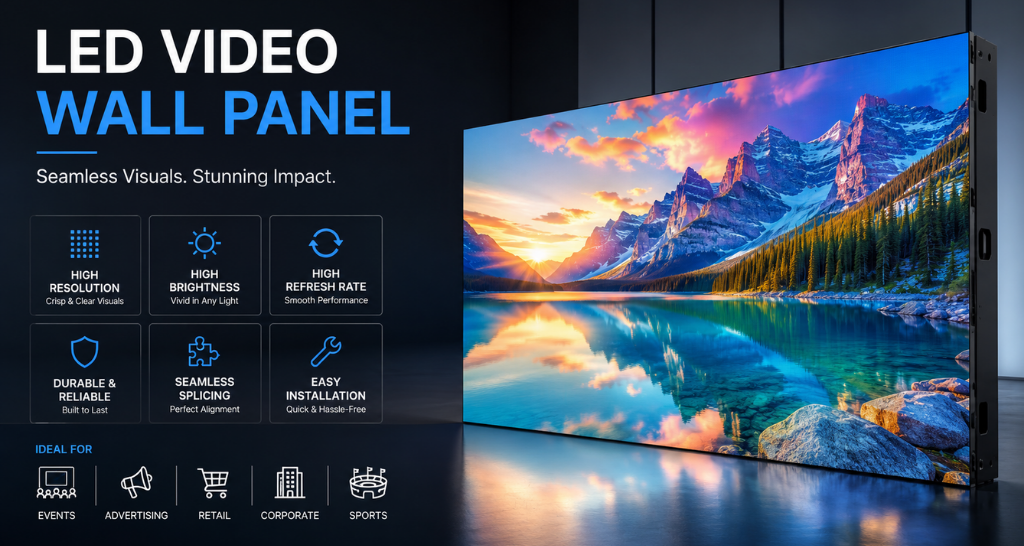
No, if one LED Video Wall Panel fails, the entire screen usually does not stop working. LED Video Walls are designed with a modular structure, where multiple panels work together as one large display. Each panel has its own LED modules, receiving card, and power components, which allows the remaining panels to continue displaying content even if one panel has an issue.
When a single panel fails, you may notice problems like:
- A black or blank section on the screen
- A panel showing incorrect colors
- Flickering or unstable display in one area
- A complete cabinet/module not lighting up
The failure is generally limited to that specific panel or module area, while the rest of the video wall continues running normally.
However, the impact depends on the type of failure:
1. LED Module Failure
If only a small LED module fails, only that small portion of the display is affected. The damaged module can usually be replaced without removing the complete screen.
2. Receiving Card Failure
If the receiving card inside a cabinet stops working, the entire cabinet may become blank because it controls the data signals for that section.
3. Power Supply Failure
A faulty power supply can make one panel turn off while other panels keep operating.
4. Data Cable or Signal Issue
Sometimes the panel itself is fine, but a loose data cable or connection problem can interrupt the signal.
Modern LED Video Wall systems are built for easy maintenance. Technicians can identify the faulty panel, replace the required component, and restore the display without replacing the complete video wall.
So, a single LED Video Wall Panel failure does not mean the whole screen will stop working it usually affects only the specific damaged area. Regular maintenance, proper installation, and quality components help reduce these failures.
What is an LED Video Wall Panel?
An LED Video Wall Panel is a modular display unit made using multiple LED modules, electronic components, and control systems. Multiple panels are connected together to create a large display surface.
Unlike traditional displays where one failure can affect the entire screen, LED video walls work through independent modules. Each panel has its own internal structure, power connection, receiving card, and LED modules.
These panels combine together to create:
- Indoor LED video walls
- Outdoor LED displays
- Control room screens
- Digital signage solutions
- Conference room displays
The modular design allows easy replacement and maintenance without removing the complete screen.
Why is an LED Video Wall Panel Important?
The importance of an LED Video Wall Panel comes from its flexibility, durability, and scalability.
Businesses choose LED video walls because they provide:
- High brightness visibility
- Large screen sizes
- Seamless display experience
- Long operational life
- Easy maintenance
A single failed panel does not normally shut down the entire display because every panel works as part of a connected system rather than a single device.
For example, if one panel stops working in a 10×10 LED video wall setup, the remaining 99 panels can continue displaying content and Audio visual solutionshttps://vallect.com/ integrate sound and display technology to deliver seamless communication, presentations, and immersive experiences for modern businesses.
How Does an LED Video Wall Panel Work?
An LED Video Wall Panel works through a combination of hardware and software technologies.
The process works like this:
1. Content Source
A media player, computer, or video processor sends the required content.
2. Video Processor
The processor divides the content according to the screen size and sends signals to different panels.
3. Receiving Cards
Each panel receives its assigned data through receiving cards.
4. LED Modules Display Content
Small LED modules inside each panel create the final image.
If one panel fails, only that specific area stops showing the correct output.
What Happens If One Panel Does Not Work?
| Situation | Result |
|---|---|
| Single panel power failure | Only that panel goes dark |
| LED module damage | Small area shows issue |
| Data cable problem | Panel may lose signal |
| Receiving card failure | Panel stops displaying content |
| Controller failure | Multiple panels may be affected |
Key Components and Technologies :
1. LED Modules
LED modules contain thousands of tiny LEDs that create images.
They are replaceable units inside each panel.
2. Cabinet Structure
The cabinet is the frame that holds:
- LED modules
- Power supplies
- Receiving cards
- Internal wiring
A group of cabinets forms a complete display.
3. Receiving Card
The receiving card controls the image information sent to each panel.
If one receiving card fails, only that section may stop displaying.
4. Power Supply System
Each panel generally has dedicated power supplies.
This reduces the chance of complete screen failure.
5. Video Processor
The processor manages:
- Resolution
- Scaling
- Signal distribution
- Multiple input sources
6. Data Cabling System
Data cables transfer image signals between the controller and panels.
A damaged cable can affect specific sections.
Facts and Figures :
- Professional LED displays can operate around 50,000 – 100,000 hours depending on quality and usage.
- Modular designs reduce repair time significantly.
- High-quality LED systems use monitoring features to detect faults early.
- Individual panel replacement can often be completed within minutes to hours depending on installation type.
- Large displays may contain hundreds or thousands of independent LED modules.
How Lightomated Helps ?
Vallect provides professional LED display solutions designed for reliable performance and easy maintenance.
Their solutions help businesses with:
- Proper LED display selection
- Installation planning
- System integration
- Technical support
- Maintenance services
A professionally installed LED Video Wall Panel system ensures better performance, longer life, and reduced chances of major downtime.