How LED Video Walls Create Immersive Retail Experiences?
Corporate offices are no longer designed only around desks, meeting rooms, and reception areas. How LED Video Walls Create Immersive Retail Experiences
Retail is no longer only about displaying products on shelves. Customers increasingly expect stores, malls, showrooms, and brand spaces to provide engaging experiences that capture attention and communicate a brand’s identity within seconds.
This is where LED Video Walls are transforming retail environments. Large-format digital displays can turn ordinary walls, entrances, storefronts, and customer areas into dynamic visual experiences. Brands can use high-resolution videos, product campaigns, animations, offers, and interactive content to create environments that encourage customers to stop, explore, and engage.
Unlike static signage, LED Video Walls can continuously change content according to campaigns, seasons, customer activity, or business objectives. Their scalability also allows retailers to create displays ranging from compact feature walls to large immersive installations.
For retailers looking to combine branding with digital communication, professionally designed LED Video Wall Solutions provide a flexible way to create memorable customer experiences.
What Makes LED Video Walls Different for Retail?
Retail environments are highly visual. Customers often make quick decisions based on what catches their attention first. A large digital display can become an important part of that first impression.
LED Video Walls use individually controlled LEDs to produce bright, detailed images without the bezels associated with conventional multi-screen LCD installations. This creates a continuous visual surface that can be customized according to the store layout.
Retailers can use these displays to showcase:
- Product launches
- Brand campaigns
- Promotional offers
- Seasonal collections
- Social media content
- Lifestyle videos
- Product demonstrations
- Corporate branding
- Interactive experiences
The result is a more flexible communication platform that can change as frequently as the retailer’s marketing strategy.
How LED Video Walls Create Immersive Experiences?
1. They Capture Attention at Entry Points
The entrance is one of the most important areas of a retail environment. A strategically positioned display can immediately communicate the brand’s identity to visitors.
High-resolution visuals, motion graphics, and promotional videos can transform an otherwise ordinary entrance into a digital brand experience.
An Indoor LED Video Wall can be particularly effective in controlled indoor environments where retailers want strong visual impact without relying on traditional printed signage.
2. They Turn Walls into Digital Brand Assets
Traditional walls remain static. LED Video Walls turn those same spaces into programmable communication surfaces.
Retailers can change the content according to:
- Morning and evening campaigns
- Seasonal promotions
- Product launches
- Festive occasions
- Flash sales
- New arrivals
This means the same physical installation can support multiple marketing campaigns throughout the year.
LED Video Walls vs Traditional Retail Displays
| Feature | LED Video Walls | Traditional Signage |
|---|---|---|
| Content | Dynamic video and graphics | Mostly static |
| Content Updates | Digital and flexible | Requires physical replacement |
| Visual Impact | High | Limited |
| Screen Size | Highly customizable | Usually fixed |
| Branding | Can change instantly | Requires new printed material |
| Customer Engagement | Interactive and motion-based | Primarily passive |
| Long-Term Flexibility | High | Limited |
The difference becomes particularly noticeable in flagship stores and premium retail environments where the visual experience is part of the brand strategy.
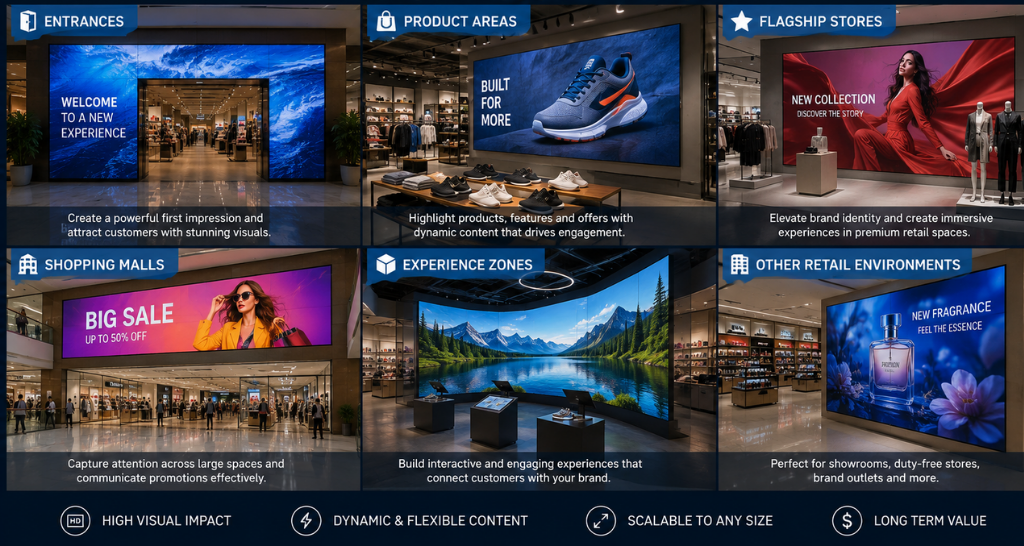
Where Can Retailers Use LED Video Walls?
Store Entrances
Large displays can welcome customers with brand videos, campaigns, or promotional content.
Product Display Areas
Retailers can use digital visuals alongside physical products to demonstrate features, use cases, or lifestyle applications.
Checkout Areas
Displays can communicate offers, loyalty programs, seasonal campaigns, and additional product recommendations while customers wait.
Shopping Mall Common Areas
Large-format installations can create advertising opportunities and increase visibility for multiple brands.
Flagship Stores
Premium retail brands can use immersive digital environments to differentiate their stores from conventional shopping spaces.
Experience Zones
Brands can combine displays with lighting, sound, and interactive technologies to create dedicated product experience areas.
Why Indoor LED Video Walls Work Well in Retail?
Retail spaces require displays that maintain image quality while operating for extended periods. An Indoor LED Video Wall provides a seamless display surface and can be configured according to viewing distance and available space.
Pixel pitch is particularly important when selecting an indoor system. Displays installed close to customers generally require finer pixel pitches to maintain sharp visuals, while larger installations viewed from farther away can use different configurations.
Brightness should also be selected according to ambient lighting. A display that is too dim may lose visibility, while excessive brightness can affect the viewing experience and TOP AV Integration in delhi.
Therefore, retail display design should consider:
- Viewing distance
- Screen dimensions
- Pixel pitch
- Brightness
- Content type
- Ambient lighting
- Installation structure
- Maintenance access
The Business Benefits of LED Video Walls:
Better Customer Engagement
Motion-based content can attract attention more effectively than static posters and printed banners.
Flexible Content Management
Retail teams can update campaigns digitally without physically replacing signage.
Stronger Brand Communication
Large displays provide more space for storytelling, product visuals, and brand messaging.
Multiple Uses from One Installation
The same display can support advertising, product demonstrations, announcements, events, and seasonal campaigns.
Premium Store Experience
A well-designed digital environment can reinforce a retailer’s positioning and create a more memorable customer journey.
What Happens If Retailers Don’t Upgrade?
Retailers that continue relying entirely on static signage may face several limitations.
Limited Content Flexibility
Changing printed campaigns requires additional design, production, and installation effort.
Lower Visual Impact
Static displays may struggle to compete for attention in busy retail environments.
Limited Storytelling
A poster communicates a single message, while digital content can combine video, animation, text, and sound.
Repeated Replacement Costs
Frequent campaigns require new physical materials, increasing operational effort and waste.
Missed Digital Experience Opportunities
Customers increasingly interact with digital content across their daily lives. A completely static retail environment may feel less engaging by comparison.
Upgrading does not mean removing all physical signage. Instead, retailers can strategically combine digital displays with existing branding and merchandising.
Creating an Immersive Retail Ecosystem
The strongest retail experiences rarely depend on one technology alone. LED Video Walls become more powerful when integrated with lighting, audio, interactive systems, and digital content management.
For example, a fashion retailer could use a large display to showcase a new collection while synchronized lighting highlights the physical products nearby. A technology showroom could combine product demonstrations with digital displays showing technical information.
Retailers can also use an LED Video Wall in Delhi NCR to create a high-impact visual presence in competitive commercial environments where multiple brands compete for customer attention.
The goal is not simply to install a large screen. The goal is to design a visual environment where technology supports the customer’s journey.
How to Select the Right LED Video Wall for Retail?
Before investing in a display, retailers should evaluate several factors.
1. Viewing Distance
Determine how close customers will typically stand to the screen.
2. Screen Size
The display should complement the architecture without overwhelming the space.
3. Pixel Pitch
Select pixel pitch based on viewing distance and required image detail.
4. Brightness
Brightness should correspond to the store’s lighting environment.
5. Content Requirements
Video-heavy campaigns may require different performance specifications than basic promotional graphics.
6. Maintenance
Consider front or rear maintenance access depending on installation conditions.
7. Content Management
A reliable content management system makes campaign updates faster and easier.
How Lightomated Helps Retaile stores?
Lightomated provides customized LED Video Wall Solutions for retail stores, shopping environments, showrooms, and branded spaces.
The process begins with understanding the retailer’s objectives, available space, viewing conditions, and content requirements. Based on these factors, the team can recommend the appropriate display size, pixel pitch, brightness, mounting configuration, and control system.
Lightomated’s support includes:
- Requirement analysis
- Site assessment
- Display design
- Pixel pitch selection
- LED cabinet configuration
- Installation and commissioning
- Content system integration
- Display calibration
- Testing
- Maintenance and technical support
The company can also design solutions for different retail environments, from compact brand walls to large immersive installations.
By combining the right hardware with appropriate content planning, retailers can transform ordinary spaces into visually engaging destinations.