Reception to Boardroom: Indoor LED Video Wall Use Cases for Corporate offices
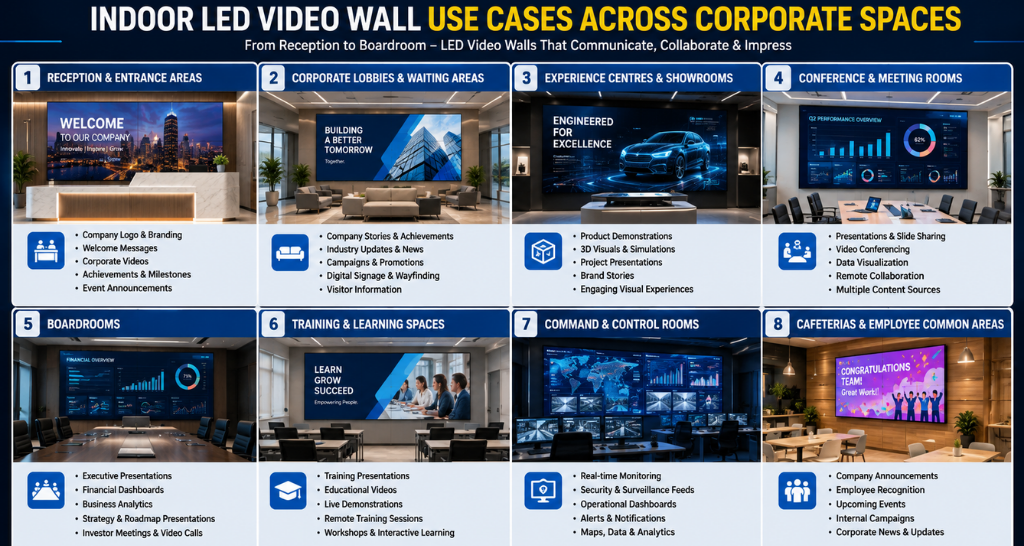
Corporate offices are no longer designed only around desks, meeting rooms, and reception areas. Businesses are increasingly using visual technology to strengthen brand identity, improve communication, present information, and create more engaging workplace experiences. An Indoor LED Video Wall can support all these requirements while offering a seamless, high-resolution display across different corporate environments.
From a reception area displaying brand content to a boardroom presenting business dashboards, LED technology can serve different purposes depending on the space, viewing distance, content type, and audience.
This makes an Indoor LED Video Wall more than a large digital screen. When properly designed and integrated, it can become an important part of a corporate communication, presentation, and visual experience strategy.
Why Are Corporates Using Indoor LED Video Walls?
Traditional displays can work well for smaller spaces, but larger corporate environments often require bigger, brighter, and more flexible visual solutions. An LED video wall can create a large seamless canvas without the visible bezels associated with multiple conventional screens.
Businesses typically consider LED video walls for several reasons:
- Stronger brand presentation: Corporate visuals, company achievements, campaigns, and welcome messages can be displayed prominently.
- Better communication: Important announcements, dashboards, and real-time information can be presented clearly.
- High-impact presentations: Large-format visuals can make boardroom and conference-room presentations more engaging.
- Flexible content: Multiple content sources can be displayed, including presentations, videos, dashboards, live feeds, and digital signage.
- Scalability: LED systems can be designed according to the available wall size and viewing distance.
- Professional workplace experience: Well-designed digital displays can contribute to a more engaging and technology-driven corporate environment.
The key, however, is selecting the right LED configuration for each application rather than using the same specification everywhere.
Indoor LED Video Wall Use Cases:
Different areas of a corporate facility have different visual and operational requirements. Here are some of the most common applications and Indoor LED Video Wall.
1. Reception and Entrance Areas
The reception is usually the first point of interaction between a visitor and an organisation. This makes it an important opportunity for businesses to communicate their identity and create a strong first impression.
An Indoor LED Video Wall at the reception can be used to display:
- Company logo and brand identity
- Welcome messages
- Corporate videos
- Company milestones and achievements
- Product and service information
- Event announcements
- Promotional campaigns
- Dynamic visual content
Instead of using a static wall or conventional signage, businesses can transform the reception into an active visual communication area.
The display should be selected according to the distance from which visitors will view it. For closer viewing distances, a finer pixel pitch can provide sharper text and detailed graphics.
2. Corporate Lobbies and Waiting Areas
Corporate lobbies often have larger open spaces and longer viewing distances than reception desks. This makes them suitable for large-format digital displays.
An Indoor LED Video Wall for corporate Lobbies can support both branding and visitor engagement. Companies can use it to showcase:
- Corporate stories
- Business achievements
- Product launches
- Industry information
- Company news
- Brand campaigns
- Visitor information
- Digital artwork and motion graphics
The content can also be updated according to business events, campaigns, seasons, or internal communication requirements and Indoor LED Video Wall.
For businesses looking for a dedicated solution for large reception and lobby environments, an Indoor LED Video Wall for corporate Lobbies should be planned around viewing distance, wall dimensions, content requirements, ambient lighting, and maintenance access.
3. Experience Centres and Showrooms
Many companies use experience centres and showrooms to demonstrate products, technologies, or services. In these environments, visual storytelling can play an important role.
An Indoor LED Video Wall can become a central presentation surface for product demonstrations, videos, graphics, simulations, and company information.
For example, a technology company may use the display to demonstrate product capabilities, while an infrastructure company may showcase project visuals, digital maps, or completed installations.
The advantage is that the same display can support different types of content rather than being restricted to a single communication purpose.
4. Conference and Meeting Rooms
Meeting rooms require a different approach because users are generally seated closer to the screen.
A corporate Indoor LED Video Wall in a meeting room can support:
- Video conferencing
- Presentation sharing
- Business dashboards
- Data visualisation
- Remote collaboration
- Training sessions
- Live content
- Multiple input sources
In this application, pixel pitch becomes particularly important. A fine-pitch LED display can provide the clarity required for presentations, spreadsheets, text, charts, and detailed visuals.
The LED display can also be integrated with cameras, microphones, speakers, video conferencing platforms, control systems, and other AV equipment to create a complete meeting-room environment.
5. Boardrooms
Boardrooms are designed for executive meetings, strategic discussions, client presentations, and decision-making. These spaces often require high-quality visuals because participants may need to review detailed charts, financial information, presentations, and business data.
An Indoor LED Video Wall can be used for:
- Executive presentations
- Financial dashboards
- Business analytics
- Strategy presentations
- Investor presentations
- Video conferencing
- Data-rich visualisations
For boardrooms, the display should be selected carefully based on viewing distance and content detail. A fine pixel pitch is generally preferred when participants sit relatively close to the screen.
The system should also provide accurate colour reproduction, appropriate brightness, reliable operation, and compatibility with the boardroom’s existing AV infrastructure.
6. Training and Learning Spaces
Corporate training rooms often need to display presentations, videos, diagrams, software demonstrations, and other educational material.
An LED video wall can provide a large visual canvas that allows participants across the room to view content clearly.
It can support:
- Employee training
- Product demonstrations
- Technical education
- Video-based learning
- Remote training
- Interactive presentations
- Workshops
For larger training facilities, LED technology can provide better visibility than relying on a small conventional display.
7. Command and Control Rooms
Command and control rooms have more demanding requirements than standard corporate spaces. Operators may need to monitor multiple dashboards, security feeds, maps, alerts, operational data, or other real-time information simultaneously.
Here, an Indoor LED Video Wall can function as a central visualisation surface.
Typical applications include:
- Network monitoring
- Security monitoring
- Business operations
- Infrastructure monitoring
- Real-time dashboards
- Emergency information
- Data visualisation
In such environments, reliability, continuous operation, content management, viewing distance, and system redundancy should be considered during the design stage.
8. Employee Cafeterias and Common Areas
LED displays are not limited to customer-facing areas. Companies can also use them for internal communication in cafeterias, lounges, breakout areas, and employee common spaces.
Content can include:
- Company announcements
- Employee recognition
- Internal campaigns
- Upcoming events
- Training information
- Corporate news
- Employee engagement content
These displays can help organisations communicate information without relying entirely on email or printed notices.
How to Choose the Right Indoor LED Video Wall for Each Space?
There is no single LED specification that is suitable for every corporate environment. The right solution depends on several factors.
Viewing Distance
Viewing distance is one of the most important considerations. A screen viewed from a short distance generally requires a finer pixel pitch, while larger displays viewed from farther away can use a relatively larger pixel pitch.
Screen Size
The available wall area should be evaluated before deciding the LED configuration. The screen should be large enough for comfortable viewing without overwhelming the room.
Content Type
A display primarily showing videos and graphics may have different requirements from one displaying spreadsheets, financial dashboards, or small text.
Brightness
Indoor spaces generally require controlled brightness compared with outdoor installations. However, areas with strong natural or artificial lighting may need a display with appropriate brightness levels to maintain visibility.
Maintenance Access
Front-maintenance or rear-maintenance configurations should be selected according to the physical installation environment. In locations where access behind the display is restricted, front maintenance can simplify servicing.
Connectivity and Integration
The LED display may need to connect with video processors, laptops, cameras, conferencing systems, control systems, digital signage platforms, and other AV equipment. Connectivity requirements should therefore be considered during system design.
Indoor LED Video Wall vs LCD Video Wall vs Projector
Corporates may also consider LCD video walls or projectors depending on the application.
| Factor | Indoor LED Video Wall | LCD Video Wall | Projector |
| Seamless appearance | Yes | Visible bezels | No panel bezels |
| Large-format display | Excellent | Good | Excellent |
| Brightness | High | High | Dependent on environment |
| Close viewing | Fine-pitch options available | Good | Depends on projection |
| Content flexibility | High | High | High |
| Suitable applications | Lobbies, boardrooms, meeting rooms, control rooms | Meeting rooms, monitoring | Large presentation spaces |
| Scalability | Highly configurable | Panel-based | Screen-based |
The best choice depends on the room, viewing distance, content, budget, and long-term operational requirements.
What Pixel Pitch Should Corporates Choose?
Pixel pitch refers to the distance between individual LED pixels. A smaller pixel pitch generally provides greater pixel density and is better suited to applications where viewers are closer to the display.
For example, a boardroom where participants sit close to the screen may require a finer-pitch solution than a large corporate lobby where visitors view the screen from several metres away.
Therefore, businesses should not select a pixel pitch only because it is smaller. The decision should consider:
- Viewing distance
- Screen dimensions
- Content detail
- Room size
- Budget
- Application requirements
A professional site assessment can help determine the appropriate specification.
Key Factors Before Installing a LED Video Wall in Corporate offices:
Before installation, organisations should evaluate the complete system rather than focusing only on the LED panels.
The planning process should include:
- Site survey – Assess wall dimensions, viewing distance, lighting, power, and access.
- Application analysis – Understand how the display will be used.
- Pixel pitch selection – Match pixel pitch with viewing distance and content.
- Display design – Determine screen size, aspect ratio, and cabinet configuration.
- Structural planning – Design the appropriate mounting structure.
- Processing and connectivity – Select suitable processors, controllers, and input sources.
- Power and thermal planning – Consider electrical load, ventilation, and heat management.
- Installation and calibration – Install, align, configure, and calibrate the display.
- Testing and handover – Test content sources, connectivity, brightness, colour, and system operation.
- Maintenance planning – Establish preventive maintenance and support requirements.
Choosing experienced LED Video Wall Solutions can help businesses address these technical considerations before installation rather than correcting them later.
How Indoor LED Video Walls Improve Corporate Communication
A well-planned Indoor LED Video Wall can contribute to more than visual aesthetics. It can support communication across multiple touchpoints within an organisation.
In reception areas, it strengthens brand communication. In meeting rooms, it supports collaboration. In boardrooms, it improves executive presentations. In control rooms, it helps operators visualise information. In employee areas, it supports internal communication.
This flexibility is one of the major reasons businesses are adopting LED technology across different corporate spaces and TOP AV Integration in delhi.
Indoor LED Video Wall Installation Process
A successful installation begins well before the LED cabinets are mounted.
The typical process includes:
Site Survey → Requirement Analysis → Screen Design → Pixel Pitch Selection → Structure Planning → LED Installation → System Integration → Calibration → Testing → Handover
The installation team should also consider future maintenance, accessibility, content management, and possible expansion.
For businesses evaluating LED Video Wall in Delhi NCR, professional site assessment is particularly useful because corporate installations can vary significantly depending on building structure, room design, ambient lighting, and available infrastructure.g-term investment for businesses seeking performance, reliability, and scalability.
How Lightomated Helps?
Lightomated helps businesses plan and implement Indoor LED Video Wall solutions based on the specific requirements of each corporate space. From reception areas and corporate lobbies to meeting rooms and boardrooms, the team evaluates factors such as viewing distance, screen size, pixel pitch, ambient lighting, content requirements, and maintenance access before recommending a suitable display configuration.
Lightomated also supports the complete implementation process, including display selection, system design, installation, calibration, and ongoing support. This approach helps businesses create reliable and visually impactful LED Video Wall Solutions that align with their branding, communication, presentation, and operational requirements.designs and installs customized Video Wall Display solutions tailored to your business requirements.