LED Display Solutions in Museums: From Static Exhibits to Immersive Storytelling
Museums have always been built around stories.
But the way visitors experience those stories is changing.
A historic photograph, preserved artifact, painting, or information panel still has value, but today’s visitors also expect visual context, movement, interaction, and a stronger sense of connection with what they are seeing.
This is where LED Display Solutions are changing the role of digital technology inside museums.
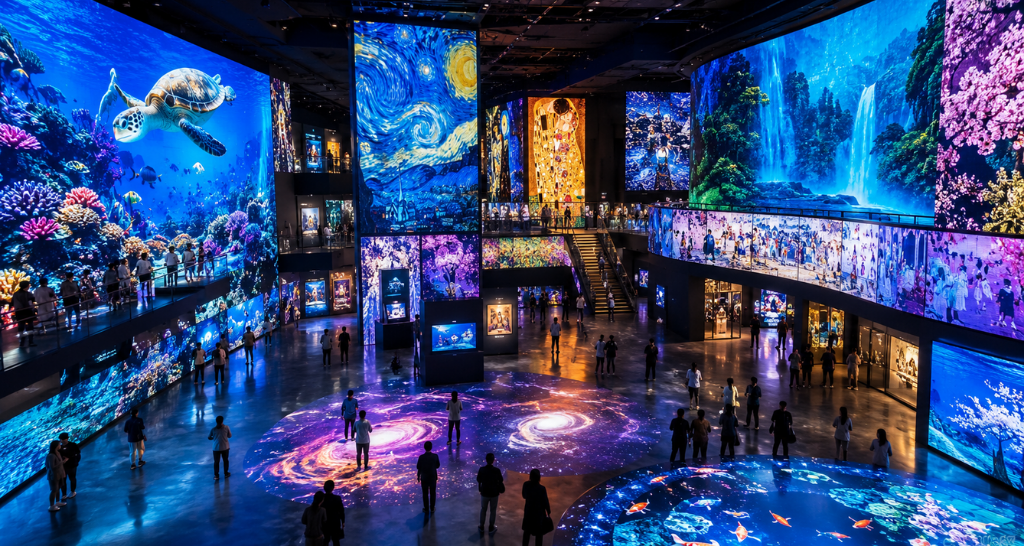
Instead of simply placing screens next to exhibits, museums can use large-format LED displays to recreate historical environments, build digital timelines, present archival footage, create immersive rooms, support interactive exhibits, and turn walls into dynamic storytelling surfaces.
The objective is not to replace physical exhibits.
It is to use technology to help visitors understand and experience the story behind them.
Why Are Museums Moving Beyond Static Displays?
Traditional museum exhibits depend heavily on artifacts, photographs, printed descriptions, models, and physical installations.
These remain essential, but they have limitations.
A single photograph can capture a moment, but it cannot always communicate what happened before or after it.
A historic object may be important, but a visitor unfamiliar with its context may not fully understand its significance.
Large text panels can provide information, but visitors may not always stop to read lengthy descriptions.
Modern LED Display Solutions allow museums to add another layer to these exhibits.
A historical artifact can be supported by archival footage.
A map can evolve into an animated timeline.
A collection of photographs can become a large-scale visual narrative.
A gallery wall can recreate changing landscapes, historic events, scientific processes, or artistic environments.
This transition from simply showing an object to building an experience around the object is one of the biggest reasons digital displays are becoming part of modern museum design.
What Role Do LED Display Solutions Play in Museum Storytelling?
An LED display should not be treated as a television installed on a wall.
When properly planned, LED Display Solutions become part of the exhibition architecture itself.
Their modular construction allows displays to be designed around the available wall size, exhibit layout, viewing distance, and content format.
For example, imagine a museum gallery explaining the development of a city over 200 years.
Instead of displaying ten separate printed maps, one large LED wall can show how roads, buildings, population, transport, and landmarks changed over time.
In a war museum, a display can combine maps, archival photographs, video, narration, timelines, and animated battle movements.
In a science museum, complex processes can be visualized at a scale that makes them easier to understand.
The display therefore becomes more than a source of information.
It becomes part of how the story unfolds.
Where Can LED Displays Be Used Inside a Museum?
Different areas of a museum have different communication requirements.
That means there is rarely one display specification suitable for the entire building.
Well-designed LED Display Solutions consider the purpose of each space before deciding the size, pixel pitch, brightness, resolution, mounting method, and content format.
1. Museum Entrance and Welcome Areas
The entrance sets the tone for the visitor experience.
A large LED wall can introduce the museum, highlight current exhibitions, display visitor information, show event schedules, or present a visual preview of what visitors will discover inside.
Because entrance displays may be viewed from different distances, display dimensions and pixel pitch should be selected according to the actual viewing environment.
An Indoor LED Display can also become an architectural feature rather than looking like an additional screen placed inside the lobby.
2. Historical Timelines
Timelines are common in history, heritage, military, institutional, and cultural museums.
Instead of presenting every event through printed text and photographs, a long-format LED wall can create a moving digital timeline.
Visitors can see dates, archival images, videos, maps, and key events in sequence.
This makes large amounts of historical information easier to explore without covering entire galleries with static panels.
3. Immersive Experience Rooms
This is where LED Display Solutions can have the greatest visual impact.
Large LED surfaces can occupy one or multiple walls to surround visitors with visual content.
For example, a museum could recreate an ancient city, battlefield, natural ecosystem, space environment, industrial process, or important historic event.
When synchronized with audio, lighting, sensors, show control, and other AV integration systems, the experience can become far more immersive than a conventional screen presentation.
The technology disappears into the experience, allowing the content to become the focus.
4. Digital Art Galleries
Digital art introduces another requirement.
The display itself becomes the canvas.
Fine-pitch LED walls can present digital artworks, motion graphics, generative art, high-resolution photography, and video installations at large scale.
In such environments, factors such as color consistency, contrast, viewing distance, refresh rate, calibration, and resolution become especially important.
The objective is not simply to make the display bright.
It is to reproduce the artist’s visual content accurately and consistently.
5. Artifact Backdrops
Physical artifacts do not always communicate their original environment.
Consider a historic vehicle, sculpture, machine, archaeological object, or military artifact.
A large LED backdrop behind the object can recreate its historical or environmental context.
A physical boat, for example, could be positioned against moving ocean imagery.
A historic aircraft could be supported by archival footage and contextual visuals.
Here, LED Display Solutions help connect a real physical object with a digital environment without replacing the authenticity of the artifact itself.
6. Interactive Exhibits
LED displays can also form part of interactive museum installations.
Touch interfaces, sensors, cameras, tracking systems, media servers, and interactive software can trigger content based on visitor actions.
The main LED wall can then act as the visual output for the experience.
This approach is particularly useful in science centres, children’s museums, technology museums, experience centres, and educational galleries.
Indoor vs Outdoor LED Displays for Museums:
Not every museum display is located inside a controlled gallery.
Museums may also require digital displays at building entrances, courtyards, outdoor exhibition areas, façades, event zones, and public-facing spaces.
An Outdoor LED Display is designed for very different environmental conditions compared with an indoor display.
Outdoor installations need to account for sunlight, rain, dust, temperature variation, weather protection, structural requirements, and longer viewing distances.
Indoor museum installations usually prioritize closer viewing, finer pixel pitch, controlled brightness, visual detail, and integration with interiors.
The decision should therefore be based on the actual environment rather than simply choosing an indoor or outdoor product category.
Pixel Pitch Matters More Than Just Resolution
One of the most important decisions when selecting LED Display Solutions for museums is pixel pitch.
Pixel pitch refers to the distance between individual LED pixels.
A smaller pixel pitch generally allows the audience to view the screen from a shorter distance while maintaining visual detail.
This is particularly important in museums because visitors often walk close to displays.
A large outdoor display designed to be viewed from tens of metres away has very different requirements from an LED wall positioned inside a gallery where visitors may stand only a few metres away.
Fine-pitch options such as P0.9, P1.2, P1.5, or other configurations may be considered depending on the content, display dimensions, viewing distance, and project budget.
The right question is therefore not:
“Which pixel pitch is the best?”
It is:
“What pixel pitch is appropriate for this viewing distance and content?”
Brightness Should Match the Museum Environment:
More brightness does not automatically mean a better display.
Museums often have carefully controlled lighting to protect artifacts and create a particular atmosphere.
An excessively bright LED wall can dominate the gallery and become uncomfortable when viewed from close distances.
At the same time, a display installed in a bright atrium or near a glass façade may need higher brightness to maintain visibility.
Professional LED Display Solutions should therefore allow brightness to be calibrated according to ambient lighting and exhibit requirements.
The display should complement the environment rather than overpower it.
Refresh Rate Becomes Important When Visitors Use Cameras
Museums are highly photographed spaces.
Visitors record videos, create social media content, photograph exhibits, and sometimes film the LED wall itself.
This makes refresh rate an important technical consideration.
A display may appear smooth to the human eye but show flickering, scanning lines, or visual artifacts when captured by a camera if the display configuration is not suitable.
Museums expecting heavy photography, professional filming, media coverage, or content production should therefore consider refresh rate during the specification stage rather than treating it as an afterthought.
Content Is as Important as the LED Wall
A technically excellent LED wall cannot compensate for poorly designed content.
Museum content should be created specifically for the physical display.
Resolution, aspect ratio, viewing distance, animation speed, text size, color, transitions, and duration all influence how visitors experience the story.
For example, content designed for a laptop screen may not work effectively on a ten-metre-wide LED wall.
Text may become oversized.
Images may lose quality.
Animations may feel too fast.
Important visual information may appear outside the natural viewing area.
For this reason, LED Display Solutions should ideally be planned alongside the content strategy rather than after the exhibition content has already been created.
LED Displays Work Better as Part of an Integrated AV System
An immersive museum experience rarely depends on video alone.
Audio, lighting, sensors, interactive systems, show control, media servers, networking, and content playback may all need to work together.
This is where professional AV integration becomes important.
Imagine an exhibit where an LED wall starts a historical film.
At a particular moment, gallery lights dim.
Directional speakers begin narration.
Another display activates.
A physical model is illuminated.
The sequence then changes automatically for the next visitor group.
For this to work reliably, the LED display cannot operate as an isolated piece of hardware.
It must communicate with the wider AV and control ecosystem.
How Can LED Displays Make Museum Stories More Immersive?
Immersion is not created simply by making a screen bigger.
It comes from coordination between the physical space, content, display, sound, lighting, and visitor movement.
Well-planned LED Display Solutions can contribute to immersion in several ways.
They can create larger visual fields that occupy more of a visitor’s peripheral vision.
They can remove the visible borders created by multiple conventional displays.
They can adapt to unusual wall dimensions.
They can display synchronized content across different surfaces.
And they can provide enough visual detail for close-range museum environments when the correct pixel pitch is selected.
The key is to design the technology around the story rather than designing the story around the technology.
Can LED Displays Replace Projectors in Museums?
Not necessarily.
LED displays and projection both have valuable museum applications.
Projection can work particularly well for large surfaces, projection mapping, irregular objects, temporary installations, and environments where projected light itself forms part of the creative concept.
LED walls, however, can be advantageous where higher brightness, strong contrast, long operating hours, consistent image visibility, or a defined digital surface is required.
They also do not depend on maintaining a clear projection path between a projector and the screen.
The right choice depends on the exhibit.
In some museums, the strongest approach may involve LED walls, projection, professional displays, interactive screens, and physical exhibits working together.
Reliability Matters in a Public-Facing Museum
A museum display may operate for many hours every day.
Unlike a temporary event screen, it becomes part of a permanent visitor experience.
If an important LED wall goes black or develops visible module failures, the problem is immediately noticeable.
Reliability therefore needs to be considered at the design stage.
Professional LED Display Solutions should consider power architecture, signal distribution, thermal management, cabinet quality, controller configuration, installation quality, spare modules, service access, and preventive maintenance.
For critical exhibits, redundancy may also be considered depending on the project requirement.
Maintenance Access Should Be Planned Before Installation
A beautiful installation can become difficult to operate if technicians cannot reach the display components.
Museums often integrate displays into finished walls, architectural structures, custom exhibits, or narrow spaces.
That makes service access an important part of the design.
Front-maintenance LED cabinets can be particularly useful where rear access is limited.
Modules, power supplies, receiving cards, and other components can then be accessed from the front of the display.
This can reduce the need for large service corridors behind the screen.
Maintenance planning should therefore happen before civil and interior work is finalized, not after the LED wall has already been installed.
Choosing the Right LED Display Solution for a Museum:
There is no universal specification for a museum LED wall.
Before selecting LED Display Solutions, project teams should evaluate:
- Purpose of the display
- Minimum and typical viewing distance
- Physical screen dimensions
- Required pixel pitch
- Content resolution and format
- Ambient lighting
- Required brightness
- Refresh rate
- Color performance
- Installation structure
- Front or rear maintenance requirements
- Operating hours
- Content management
- Media server and playback requirements
- Audio and control integration
- Network infrastructure
- Maintenance and support requirements
- Future scalability
The cheapest display specification may not provide the lowest long-term cost.
Likewise, the highest specification may be unnecessary for every museum area.
The objective should be to match technology with the actual visitor experience and operational requirement.
Why System Design Matters More Than Screen Size
A large screen can attract attention.
But screen size alone does not create an effective museum installation.
The best LED Display Solutions begin with questions about the space.
How close will visitors stand?
How many people will view the content simultaneously?
Will visitors be moving or seated?
Will the screen be photographed?
What type of content will be displayed?
How bright is the surrounding environment?
How will technicians access the display?
Does the display need to synchronize with audio, lighting, sensors, or other screens?
These questions influence the technical design far more than simply choosing the largest available LED wall.
For projects looking for an LED Video Wall in Delhi NCR, the same design approach is important.
Site conditions, architectural constraints, content requirements, installation, commissioning, and long-term support should all be considered as part of the solution.
From Display Technology to Storytelling Technology
The most successful museum technology is often the technology visitors stop thinking about.
They remember the story.
They remember standing inside a historical scene.
They remember watching an old city develop around them.
They remember seeing an artifact come alive through archival footage.
They remember an artwork filling an entire wall.
That is the real opportunity offered by LED Display Solutions.
Instead of treating an LED wall as another digital screen, museums can use it as a storytelling surface that connects physical artifacts with digital context.
Combined with thoughtful content, architecture, audio, lighting, control, and interactive technologies, LED Display Solutions can help transform static galleries into environments that visitors can see, hear, explore, and remember.