How LED Display Maintenance & Support Help Prevent Unexpected Failures?
It is 6:30 PM at a busy retail store.
The LED video wall has been running since morning, displaying promotional content across a large section of the store.
Suddenly, one cabinet goes black.
A few minutes later, another section begins flickering.
The content is still running, the controller appears normal, and nobody changed the system configuration.
So, what happened?
To the store team, the LED display failed without warning.
But inside the display, the problem may have been developing for weeks.
A power supply could have been overheating.
A data connection may have gradually become unstable.
Dust could have restricted airflow inside the cabinet.
A receiving card might have been showing intermittent communication errors.
These small issues often remain unnoticed until they finally affect the screen.
This is where LED Display Maintenance & Support becomes important.
The purpose of maintenance is not simply to repair an LED display after something fails.
It is to identify developing problems, maintain system health, reduce unplanned downtime, and keep the display performing consistently throughout its operating life.
What Happens If My LED Display Suddenly Stops Working?
When an LED display suddenly stops working, the first reaction is usually to check the screen itself.
But an LED display is not a single piece of hardware.
It is a complete system consisting of LED modules, power supplies, receiving cards, data cables, power distribution, controllers, processors, cooling components, software, and supporting electrical infrastructure.
A failure anywhere in this chain can affect the final image.
For example, if a single LED module fails, only a small section of the display may become black.
If a receiving card develops a problem, an entire cabinet or group of modules may lose content.
A faulty power supply can cause intermittent shutdowns or dark sections.
A loose data connection may create flickering, image distortion, or signal loss.
A controller or processor problem can potentially affect the complete LED wall.
The challenge is that these failures do not always happen instantly.
An unstable connector might work normally for days before finally losing communication.
A power supply operating at unusually high temperatures may continue functioning until prolonged heat damages it.
This is why LED Display Maintenance & Support should focus on identifying the condition behind the failure rather than simply replacing whatever stopped working, helping LED Video Wall Solutions maintain reliable performance and reduce the risk of recurring issues.
Are LED Display Failures Really Unexpected?
Not always.
Many LED display problems appear sudden to the user because the early warning signs were never noticed.
Think of a power supply operating above its normal temperature.
The screen may continue working perfectly.
Nothing appears wrong from the front.
But prolonged heat can gradually affect component reliability.
Eventually, the power supply fails and a section of the display goes black.
From the operator’s perspective, the failure happened in seconds.
From the system’s perspective, it may have been developing for months.
Common conditions that can eventually cause LED display problems include:
- Loose power connections
- Unstable data cables
- Dust accumulation
- Restricted cabinet ventilation
- Overheating components
- Aging power supplies
- Receiving card communication errors
- Damaged LED modules
- Moisture ingress
- Irregular electrical supply
- Improper grounding
- Cooling fan problems
- Controller configuration issues
- Physical cabinet damage
Regular LED Display Maintenance & Support gives technicians an opportunity to identify these conditions early, especially in an Outdoor LED Display exposed to changing weather, dust, heat, and moisture, before they develop into major operational problems.
What Happens When LED Display Maintenance Is Ignored?
An LED wall rarely moves directly from perfect performance to complete system failure.
Problems often start small.
You may notice a few dead pixels.
Then one module begins showing slightly different colors.
A section occasionally flickers.
The screen needs to be restarted more frequently.
One cabinet becomes noticeably warmer than the others.
Eventually, the small irregularity becomes a visible or operational failure.
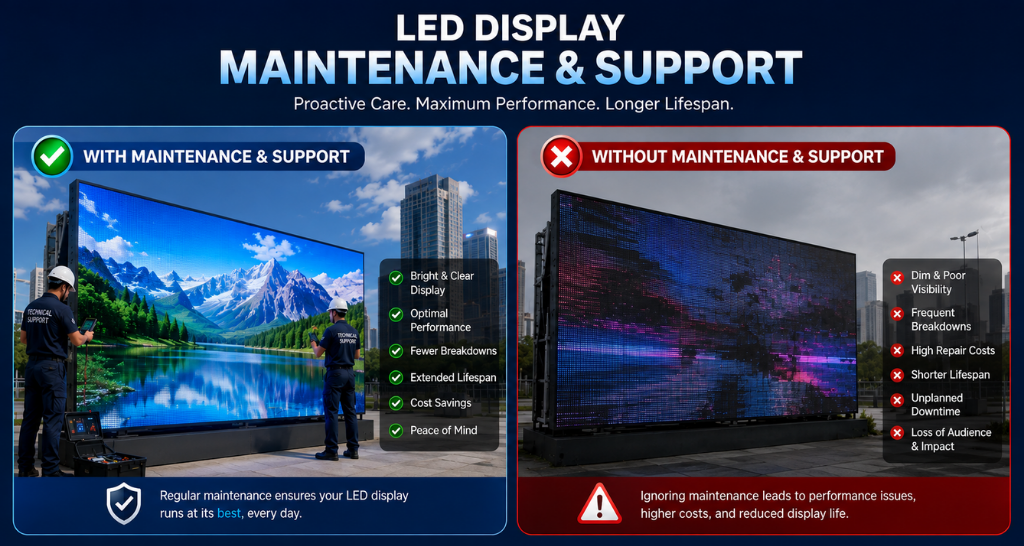
Ignoring these symptoms can result in black modules, brightness inconsistency, color variation, intermittent signal loss, overheating, unexpected restarts, power supply failures, or complete sections of the LED wall becoming unavailable.
The impact also depends heavily on where the LED display is installed.
A black section on a retail LED wall can disrupt an active advertising campaign.
A malfunctioning screen inside a corporate reception area affects the visitor experience.
Failure during an auditorium event can interrupt presentations or live content.
For a control room display operating continuously, downtime can interfere with monitoring and decision-making.
This is why maintenance requirements should be based on the application, operating hours, environment, and criticality of the display, whether it is an Indoor LED Display operating in a controlled environment or a system exposed to more demanding conditions.
Preventive Maintenance vs Breakdown Maintenance
There are two very different ways to manage an LED display.
The first is to wait for something to fail.
The second is to look for conditions that could cause failure.
That difference defines breakdown and preventive maintenance.
| Preventive Maintenance | Breakdown Maintenance |
|---|---|
| Problems are identified early | Action begins after failure |
| Maintenance can be scheduled | Repair is usually unplanned |
| Components are regularly inspected | Components are checked after an issue |
| Potential failures can be addressed | Failed components require immediate action |
| Downtime can often be planned | Downtime is unpredictable |
| System health is documented | Focus remains on restoring operation |
Breakdown maintenance may appear cheaper because there are fewer scheduled service visits.
However, this approach does not account for the business cost of unexpected downtime.
With preventive LED Display Maintenance & Support, the objective is to move maintenance from an emergency activity to a planned operational process.
How LED Display Maintenance Helps Prevent Failures
Effective maintenance goes much deeper than cleaning the LED screen.
Technicians need to inspect the different layers that allow the display to operate reliably.
1. Visual Inspection
A visual inspection can reveal early signs of problems such as dead pixels, damaged modules, uneven brightness, abnormal colors, loose cabinets, flickering areas, or physical damage.
Small visual inconsistencies should not automatically be considered cosmetic issues.
They can sometimes indicate problems deeper inside the system.
2. Power System Checks
Power-related problems are one of the areas that should be checked during LED Display Maintenance & Support.
Technicians can inspect power supplies, distribution systems, power cables, connectors, grounding, and individual cabinet power conditions.
Loose connections, excessive heat, or abnormal power behavior can then be investigated before they cause larger failures.
3. Data and Signal Inspection
The image reaching an LED module travels through multiple components.
Controllers, processors, sending cards, receiving cards, network cables, and internal data connections all form part of that signal path.
A weak connection anywhere in the chain can result in flickering, missing content, distorted images, or complete signal loss.
Checking the signal chain helps identify unstable connections before they become permanent failures.
4. Thermal Management
Heat is an important factor in LED display reliability.
Displays operating for long hours generate continuous heat inside cabinets.
Ventilation paths, cooling systems, fans, and cabinet temperatures therefore need periodic attention.
Blocked airflow or failing cooling components can cause internal temperatures to rise.
Regular LED Display Maintenance & Support can identify unusual heat conditions before they start affecting sensitive electronic components.
5. Cleaning and Dust Management
Dust does more than make a display look dirty.
Inside a cabinet, accumulated dust can restrict ventilation and affect cooling efficiency.
The level of cleaning required depends on the installation environment.
A display operating inside a controlled boardroom as part of an AV integration setup has very different exposure compared with a display installed in a retail environment, gym, public venue, or outdoor location.
6. Structural Inspection
Large LED walls consist of multiple cabinets mounted together to create one seamless visual surface.
Mounting structures, cabinet locks, alignment, connectors, and accessible structural components should be inspected periodically.
This becomes especially important for large-format and long-term installations.
7. Software, Configuration and Calibration
Not every display issue is caused by hardware.
Incorrect configuration, controller settings, firmware issues, or calibration inconsistencies can also affect performance.
Keeping configuration backups and checking system settings makes troubleshooting faster when something changes unexpectedly, helping ensure reliable performance of an LED Video Wall in Delhi NCR across different commercial and operational environments
Warning Signs You Should Never Ignore
LED displays often communicate that something is wrong before they completely fail.
The problem is that these signs are easy to dismiss when the screen is still operational.
Watch for recurring flickering, random black modules, intermittent signal loss, unusual color shifts, brightness differences, frequent restarts, unusually hot cabinets, repeated communication errors, delayed startup, or recurring power supply issues.
A single flicker may not mean the display is about to fail.
But repeated flickering in the same section deserves investigation.
Similarly, restarting the system may temporarily restore a faulty cabinet, but it does not necessarily remove the underlying cause.
Good LED Display Maintenance & Support looks at recurring patterns instead of treating each symptom as an isolated incident.
Why Technical Support Matters Alongside Maintenance
Maintenance and technical support perform different roles.
Maintenance is primarily preventive.
Support becomes critical when something abnormal occurs.
Imagine an LED display developing a signal problem shortly before an important event.
Waiting several days for the next scheduled maintenance visit is not practical.
Technical support allows the problem to be diagnosed and addressed quickly.
Depending on the system and service arrangement, support may include remote troubleshooting, controller checks, configuration assistance, fault isolation, on-site technician visits, replacement coordination, and escalation to the manufacturer when required.
A strong LED Display Maintenance & Support plan therefore needs both scheduled preventive activities and responsive technical assistance.
Remote Diagnostics Can Reduce Troubleshooting Time
Modern LED display systems can provide technicians with valuable operational information.
Depending on the display architecture and monitoring capabilities, teams may be able to check receiving card communication, signal status, controller conditions, temperature information, power conditions, and system alerts.
Remote access can also help determine whether the problem originates from the display hardware, processor, controller, configuration, or incoming signal.
Consider a display where three cabinets suddenly stop showing content.
Without diagnostics, a technician may need to inspect multiple possible causes physically.
With proper monitoring information, the support team may identify that all three cabinets are connected through the same affected signal path.
The problem becomes much easier to isolate.
Remote diagnostics cannot eliminate the need for physical maintenance.
But combined with LED Display Maintenance & Support, it can significantly improve fault identification and reduce unnecessary troubleshooting time.
Spare Parts Planning Is Part of Reliable LED Display Support
Imagine that a technician identifies a failed power supply within an hour.
The diagnosis is complete.
But the correct replacement power supply is unavailable.
The display remains partially down.
This is why spare-part planning should be considered part of maintenance strategy.
Depending on the installation, critical spares may include LED modules, receiving cards, power supplies, data cables, connectors, and other manufacturer-recommended components.
Spare planning becomes particularly important for installations where downtime has a high operational impact.
The exact inventory should depend on display size, hardware architecture, component availability, operating environment, and expected service life.
Effective LED Display Maintenance & Support is not only about identifying a failed component quickly.
It is also about being prepared to restore the system efficiently.
Maintenance Requirements Change With the Application
There is no universal maintenance schedule that works for every LED display.
An indoor LED wall operating eight hours per day inside an air-conditioned office experiences very different conditions from an outdoor display running continuously.
Indoor Corporate LED Displays
Corporate LED walls usually operate in controlled environments.
Maintenance may focus more heavily on visual consistency, dust management, power systems, signal integrity, calibration, and controller configuration.
Retail LED Displays
Retail displays often operate for long hours every day.
Because they directly support advertising and customer experience, even a small black section can become highly visible.
Preventive LED Display Maintenance & Support should therefore focus strongly on uptime and quick fault response.
Outdoor LED Displays
Outdoor installations face additional environmental stress.
Heat, rain, humidity, dust, temperature fluctuations, and continuous exposure can increase maintenance requirements.
Cabinet sealing, ventilation, power connections, structural condition, and weather protection become especially important.
Control Room LED Walls
Control rooms may require displays to operate continuously.
Here, maintenance needs to be carefully planned because the display may support operational monitoring.
Redundancy, system health checks, rapid support, spare availability, and planned maintenance windows become much more important.
Auditorium LED Walls
Auditorium displays may not operate continuously, but failure during an event can have a major impact.
Pre-event checks of signal paths, processors, power systems, modules, and content sources can therefore be just as important as routine maintenance.
What Should an LED Display AMC and Support Plan Cover?
An Annual Maintenance Contract should provide more than occasional technician visits.
The exact scope will vary depending on the installation, but a structured AMC can include:
- Scheduled preventive maintenance visits
- Display health inspections
- Module and cabinet checks
- Power supply inspection
- Signal and data-path checks
- Cleaning where required
- Temperature and ventilation checks
- Controller and processor inspection
- Calibration checks
- Remote troubleshooting
- On-site technical support
- Spare-part coordination
- Service documentation
- Fault history tracking
- Defined response and escalation procedures
A useful LED Display Maintenance & Support plan should also document recurring problems.
If the same cabinet experiences three power-related issues within a few months, treating each event separately may hide the actual pattern.
Maintenance records allow technicians to identify repeated faults and investigate the underlying cause.
How Often Should an LED Display Be Maintained?
There is no single maintenance frequency for every LED installation.
The schedule should consider operating hours, installation environment, display type, manufacturer recommendations, system criticality, accessibility, and previous fault history.
A basic maintenance framework could include regular visual monitoring, periodic system health checks, quarterly technical inspections, and comprehensive annual assessments.
Displays operating continuously or in harsh outdoor conditions may require more frequent attention.
The important point is consistency.
LED Display Maintenance & Support works best when it follows a planned schedule rather than beginning only after performance starts declining.
Maintenance Cost vs Unexpected Downtime
Maintenance has a visible cost.
Downtime often has a hidden one.
Consider the difference between identifying an overheating power supply during a planned inspection and having that power supply fail during operating hours.
In the first situation, the component can potentially be replaced during scheduled downtime.
In the second, the display fails unexpectedly, troubleshooting begins under pressure, replacement availability becomes urgent, and business operations may be affected.
The chain often looks like this:
Small issue → ignored symptom → component degradation → failure → emergency support → unexpected downtime.
Preventive maintenance changes the sequence:
Early warning → inspection → diagnosis → planned corrective action → reduced disruption.
That is the real value of LED Display Maintenance & Support.
It does not mean an LED display will never experience a hardware failure.
Electronic components can still fail.
Instead, maintenance reduces avoidable failures, identifies developing issues earlier, and creates a structured process for responding when problems occur.
Moving From Reactive Repairs to Preventive LED Display Support
Installing an LED display is only the beginning of its operational life.
The system may be expected to run for thousands of hours while maintaining brightness, color consistency, signal stability, and reliable performance.
Waiting for something to stop working before inspecting the system creates unnecessary risk.
A better approach combines regular inspection, preventive maintenance, remote diagnostics, technical support, service records, and appropriate spare-part planning.
That is what effective LED Display Maintenance & Support should achieve.
The goal is not simply to repair a black module faster.
The goal is to understand why it failed, identify similar risks elsewhere in the system, and reduce the chances of the same problem disrupting the display again.
Because in many cases, an “unexpected” LED display failure was giving warning signs long before the screen went black.
LED Display Maintenance & Support by Lightomated
Lightomated provides LED Display AMC & Maintenance Support to help businesses maintain display performance and minimize unexpected downtime.
Our support covers preventive inspections, fault diagnosis, module and component checks, troubleshooting, and timely technical assistance to keep LED video walls operating reliably.