LED Video Wall vs TV vs Projector: which is best for your Space?
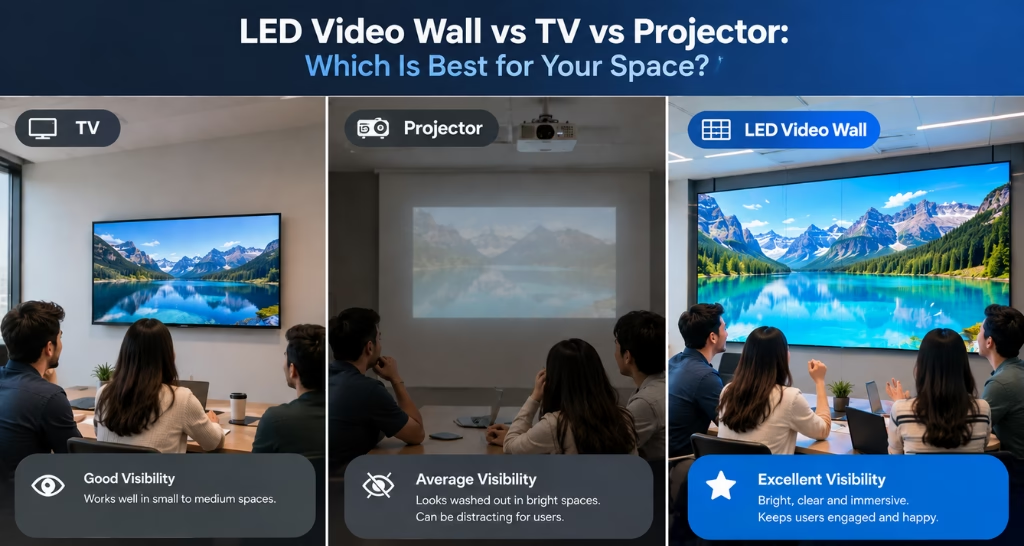
Choosing the right display for a commercial or professional space is not always as simple as picking the biggest screen. TVs, projectors and LED video walls can all display presentations, videos, advertisements and digital content, but they perform very differently depending on the space, viewing distance, lighting conditions and intended use.
TV may be practical for a small meeting room, while a projector can work well when a large image is required in a controlled-light environment. But when the requirement is a large, bright, seamless and high-impact display, an LED Video Wall Solution can offer significant advantages.
So, which display technology is right for your space? Let’s compare LED video walls, TVs and projectors across the factors that matter most.
LED Video Wall, TV and Projector: What Is the Difference?
Before choosing a display, it is important to understand how these technologies differ.
| Feature | LED Video Wall | TV | Projector |
| Display Technology | Direct-view LED | LCD/LED panel | Projected image |
| Brightness | Excellent | good | Depends on projector and lighting |
| Large Screen Sizes | Excellent | Limited | Excellent |
| Image Visibility in Bright Areas | Excellent | Good | Can reduce |
| Seamless Large Display | Yes | No, bezels are visible | Yes |
| Outdoor Use | Excellent with suitable models | Limited | Generally unsuitable |
| Scalability | Highly scalable | Limited | Flexible |
| Maintenance | Module/component based | Full-unit replacement | Lamp/filter/laser maintenance |
| Best For | Large-scale, high-impact displays | Small and medium spaces | Controlled-light environments |
The biggest difference is scalability and performance. A TV has a fixed screen size, while a projector creates a large image by projecting light onto a surface. An LED Video Wall uses individual LED modules to create a direct-view display that can be built in different sizes and aspect ratios.
This makes LED technology particularly suitable when the display itself needs to become an important part of the environment.
Which Is Better for Indoor Spaces?
For indoor spaces, the best display depends on the size of the room, viewing distance, ambient lighting and the type of content being displayed.
TV
A professional TV or commercial display can be a practical choice for smaller spaces such as:
- Small meeting rooms
- Reception areas
- Small retail spaces
- Private offices
- Limited-viewing-distance applications
For these environments, a TV can provide good image quality without requiring a complex installation. However, as the required screen size increases, using multiple TVs can create visible bezels between screens. This can affect the overall viewing experience and make the display appear less seamless.
Projector
Projectors are commonly used in:
- Training rooms
- Classrooms
- Presentation spaces
- Conference rooms
- Auditoriums
They can create a large image without requiring a physically large display. However, projector performance depends heavily on ambient lighting. Windows, artificial lights and other sources of brightness can reduce image visibility and contrast.
Indoor LED Video Wall
An Indoor Video Wall becomes a stronger option when the space requires a large, seamless and visually impactful display.
It is suitable for:
- Corporate lobbies
- Conference & Boardrooms
- Experience centres
- Large meeting rooms
- Control rooms
- Smart Classrooms
- Auditoriums
- Retail environments
- Brand experience spaces
- Large reception areas
Unlike a projector, an LED Video Wall produces light directly from the display surface. This allows content to remain bright and clear even in spaces with significant ambient lighting. When the objective is to combine large screen size, brightness, seamless visuals and strong visual impact, an Indoor Video Wall can provide a more capable solution than a conventional TV or projector.
Which Is Suitable for Outdoor Spaces?
Outdoor environments create very different display requirements. Direct sunlight, changing weather conditions, long viewing distances and high ambient brightness can make conventional display technologies difficult to use effectively.
| Outdoor Requirement | LED Video Wall | TV | Projector |
| Sunlight Visibility | Excellent with suitable brightness | Limited | Poor |
| Large Viewing Distance | Excellent | Limited | Variable |
| Weather-Ready Options | Available | Limited | Difficult |
| Large-Scale Advertising | Excellent | Limited | Less Practical |
| High Visual Impact | Excellent | Moderate | Variable |
For outdoor applications such as advertising, building façades, stadiums, public spaces and commercial displays, an Outdoor Video Wall is generally the more practical choice.
Outdoor LED displays are designed with brightness and environmental requirements in mind. Their ability to produce high-brightness visuals makes content easier to see from a distance, even in challenging outdoor conditions.
A TV may work for a small sheltered outdoor application, but it is not designed to provide the same level of scale and visibility. Projectors face an even bigger challenge because ambient and natural light can significantly affect the projected image. For large outdoor communication and advertising requirements, LED technology therefore has a clear advantage.
Best Option Based on Room Size and Viewing Distance
Screen size alone should not determine which display you choose. Viewing distance is equally important. A display that looks impressive from a short distance may not provide the same experience when viewers are standing much farther away.
| Space / Viewing Condition | TV | Projector | LED Video Wall |
|---|---|---|---|
| Small room, <10 ft viewing | ★★★ | ★★ | ★★★★★ |
| Medium room, 10–20 ft | ★★★ | ★★★ | ★★★★★ |
| Large room, 20–40 ft | ★ | ★★★ | ★★★★★ |
| Large hall / auditorium | ★ | ★★★ | ★★★★★ |
| Large lobby | ★★ | ★★ | ★★★★★ |
| Control room | ★★ | ★ | ★★★★★ |
| Retail experience area | ★★★ | ★★ | ★★★★★ |
| Outdoor / long-distance viewing | ★ | ★ | ★★★★★ |
For smaller spaces, a TV can be the simplest and most economical option. Projectors become useful when a larger image is required and lighting can be controlled.
However, as the space becomes larger and the requirement for brightness, visibility and visual impact increases, an LED Video Wall becomes increasingly attractive.
This is particularly important for corporate lobbies, retail environments, control rooms and large commercial spaces where the display needs to be clearly visible to multiple viewers at the same time.
Brightness and Lighting Conditions
Lighting is one of the most important factors when selecting a display. indoor environments are not always dark or controlled. Large windows, glass façades, ceiling lights, spotlights and retail lighting can all affect how content appears on a screen.
Projectors are particularly sensitive to these conditions because the image is projected onto a surface. Even a powerful projector can struggle when there is significant ambient light. as part of a complete Audio Visual Integration solution, LED Video Walls generate light directly from the LED modules, allowing the display to maintain strong visibility even in bright indoor environments
The difference becomes even more important outdoors. direct sunlight creates an extremely bright viewing environment, making brightness a critical requirement for outdoor displays. An appropriately specified Outdoor Video Wall can provide the brightness needed to maintain content visibility in these conditions. simply put, the more challenging the lighting environment, the more important display brightness becomes and this is one of the areas where LED technology provides a major advantage.
Installation, Maintenance and Long Term Cost
Initial price is important, but it should not be the only factor considered when choosing a display. a TV generally has a lower upfront cost and can be relatively simple to install. However, creating a very large display using multiple TVs can increase the number of screens, mounting requirements and visible bezels.
Projectors can also provide a large image at a comparatively lower initial investment. However, maintenance requirements, brightness degradation and the need for suitable lighting conditions should be considered over the system’s operating life. an LED Video Wall generally requires a higher initial investment, but it provides greater scalability and is designed specifically for large-format applications.
| Investment Factor | LED Video Wall | TV | Projector |
|---|---|---|---|
| Budget Flexibility | Flexible | Limited | Moderate |
| Large-Scale Display | Excellent | Requires multiple units | Excellent |
| Scalability | High | Limited | High |
| Maintenance | Module/component based | Unit replacement | Lamp/filter/laser dependent |
| Long-Term Flexibility | High | Moderate | Moderate |
Another advantage of LED technology is its modular construction. If a component requires servicing, individual modules or components can generally be addressed instead of replacing an entire large display. therefore, the right approach is to compare total value, performance and long-term requirements, rather than looking only at the initial purchase price.
How Lightomated Helps You Choose the Right LED Video Wall?
Choosing an LED Video Wall is not simply about selecting the largest or brightest screen. The right solution depends on where the display will be installed, how far viewers will be from it, what type of content will be shown and what lighting conditions the display will operate in. lightomated specialises in indoor and outdoor LED video wall solutions, helping businesses select display solutions according to their specific application.
For indoor environments, an Indoor Video Wall can be designed for applications such as corporate spaces, retail environments, reception areas, experience centres and control rooms. for outdoor requirements, an Outdoor Video Wall can be considered for advertising, building façades, stadiums, public spaces and other large-scale commercial applications.
The selection process should consider factors such as screen size, pixel pitch, brightness, viewing distance, installation environment, content requirements and expected operating conditions. by evaluating these factors before installation, businesses can choose an LED Video Wall that delivers the required visual performance while fitting the practical requirements of the space.