How HDR Technology Improves Visual Quality in LED Displays
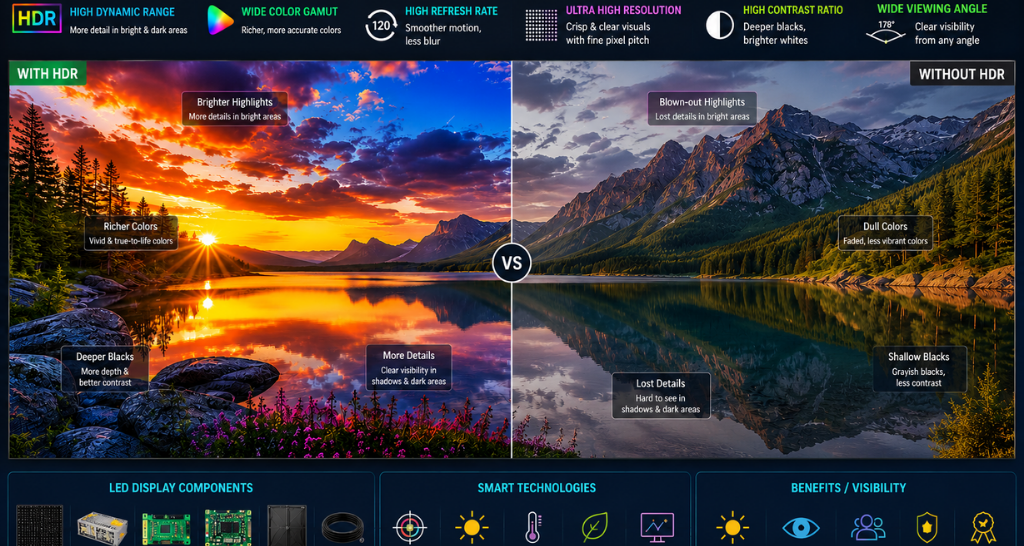
HDR technology significantly enhances visual performance in Indoor LED Displays by delivering improved brightness, contrast, and color accuracy. It ensures deeper blacks and brighter highlights, creating a more realistic viewing experience. With HDR, Indoor LED Displays provide superior image clarity, better depth, and immersive visual communication in all lighting conditions.
This technology also reduces color banding and improves smooth gradients, making visuals appear more natural and detailed. As a result, content on Indoor LED Displays looks more engaging and impactful for audiences in corporate, retail, and control room environments.
Why Do Some LED Displays Look Stunning While Others Appear Flat and Washed Out?
Organizations today rely heavily on visual communication. Whether it is a corporate boardroom, experience center, retail showroom, command center, educational institution, or hospitality venue, display technology plays a major role in audience engagement. Yet many businesses invest in display systems only to discover that their content lacks impact. Images appear dull, colors seem inaccurate, and important visual details disappear in bright or dark scenes.
This challenge has increased the demand for advanced indoor LED displays that can deliver exceptional image quality in professional environments. As organizations seek more immersive visual experiences, High Dynamic Range (HDR) technology has emerged as one of the most important innovations in display engineering.
Modern audiences expect crystal-clear visuals, realistic colors, and seamless viewing experiences. This is where HDR technology in LED displays is changing the game. By improving brightness, contrast, color accuracy, and image depth, HDR creates visuals that appear more natural and engaging than conventional display systems.
This article explores how HDR improves performance, the technologies behind it, its business impact, and how Lightomated helps organizations implement next-generation display solutions..
Understanding HDR and Why It Matters?
HDR stands for High Dynamic Range. It refers to the capability of a display to reproduce a wider range of brightness levels, contrast ratios, and colors compared to standard display technologies.
The biggest advantage of HDR technology in LED displays is its ability to reveal details in both the brightest and darkest parts of an image simultaneously.
Imagine a corporate presentation containing a city skyline at sunset. Traditional displays may either brighten the sky while losing building details or preserve the buildings while washing out the sky. HDR allows both elements to remain visible and realistic.
This enhancement dramatically improves viewing experiences across various applications using indoor LED displays.
Organizations often compare HDR vs SDR displays when evaluating new display investments. SDR, or Standard Dynamic Range, has been the traditional display standard for years. While effective for basic content, SDR lacks the advanced brightness and contrast capabilities needed for modern visual experiences.
When comparing HDR vs SDR displays, the differences become immediately visible through richer colors, improved depth, and enhanced realism.
Core Technologies Behind HDR Performance :
HDR is not a single technology. Instead, it combines multiple innovations that work together to deliver exceptional visual performance.
Advanced Brightness Management
One of the foundations of HDR technology in LED displays is enhanced brightness control.
HDR-enabled systems can produce brighter highlights while maintaining detail throughout the image. This capability allows indoor LED displays to present content with greater realism and impact.
Bright whites appear cleaner, reflections become more realistic, and visual depth increases significantly.
Superior Contrast Ratios
Contrast determines the difference between the darkest black and brightest white visible on a screen.
Improved contrast is essential for achieving superior LED display visual quality. HDR systems maintain deep blacks while simultaneously delivering bright highlights, creating more dynamic images.
Organizations evaluating HDR vs SDR displays frequently identify contrast enhancement as one of the most noticeable improvements.
Expanded Color Reproduction
HDR systems support broader color gamuts, enabling displays to reproduce more colors accurately.
As a result, indoor LED displays can present vibrant branding materials, realistic photographs, and immersive video content with exceptional precision.
The color improvements delivered by HDR technology in LED displays are especially valuable in environments where visual communication directly influences customer experiences.
Fine Pixel Pitch Technology
Pixel pitch refers to the distance between LED pixels.
Smaller pixel pitches create sharper images and allow viewers to sit closer to the display without noticing pixel structures.
This is why many organizations choose fine pixel pitch HDR displays for boardrooms, executive briefing centers, and collaborative workspaces.
The combination of HDR and fine pixel pitch technology produces remarkable clarity and image realism.
HDR Technology vs Standard Display Output
When discussing display upgrades, organizations often compare HDR vs SDR displays to understand the return on investment and discover advanced AV solutions that improve communication, collaboration, and control. Build seamless, scalable, and future-ready audio visual systems for modern smart spaces.
Several differences separate the two technologies.
Brightness Performance
In comparisons between HDR vs SDR displays, HDR consistently delivers superior highlight detail and visual impact.
Contrast Enhancement
The enhanced contrast capabilities available through HDR create significantly more immersive experiences than standard systems.
Color Accuracy
Businesses seeking better LED display visual quality benefit from HDR’s expanded color reproduction capabilities.
Realistic Visual Experiences
When reviewing HDR vs SDR displays, decision-makers frequently note that HDR content appears more natural and lifelike.
Future-Ready Infrastructure
As more content creators adopt HDR standards, organizations investing in HDR-compatible indoor LED displays position themselves for long-term success.
Solving Common Visual Challenges with HDR
Many organizations experience recurring display-related issues.
Challenge 1: Washed-Out Content
Traditional systems often struggle with color consistency.
By implementing HDR technology in LED displays, organizations can achieve richer colors and stronger visual engagement.
Challenge 2: Loss of Detail
Complex content frequently contains bright and dark elements within the same image.
HDR preserves details across the entire visual spectrum, significantly improving LED display visual quality.
Challenge 3: Viewer Fatigue
Poor contrast and color reproduction can make prolonged viewing uncomfortable.
Advanced indoor LED displays equipped with HDR capabilities create more comfortable and engaging viewing experiences.
Challenge 4: Inconsistent Presentation Quality
Organizations often present content from multiple sources.
Modern HDR technology in LED displays helps maintain visual consistency regardless of content type.
Challenge 5: Limited Audience Engagement
Businesses looking to increase engagement often upgrade to fine pixel pitch HDR displays because they create more immersive visual experiences.
Business Impact of HDR-Enabled Indoor LED Displays
The value of HDR extends far beyond aesthetics.
Organizations investing in advanced indoor LED displays frequently experience measurable business benefits.
Enhanced Brand Perception
Premium visual experiences strengthen brand credibility and professionalism.
Improved LED display visual quality contributes directly to stronger audience impressions.
Better Collaboration
Modern workplaces depend on effective communication.
High-performance indoor LED displays improve presentation clarity and support more productive meetings.
Greater Audience Engagement
Visitors naturally engage more with dynamic content presented through HDR-enabled systems.
This is particularly true when organizations deploy fine pixel pitch HDR displays in customer-facing environments.
Improved Decision-Making
Clearer dashboards, analytics, and visual data contribute to faster and more informed decisions.
This advantage further highlights the value of HDR technology in LED displays.
Future Scalability
Businesses evaluating HDR vs SDR displays often choose HDR because it supports future content standards and evolving digital communication requirements.
How Lightomated Helps Organizations Achieve Superior Visual Performance
Selecting the right display technology requires more than choosing a screen.
Lightomated helps organizations design, deploy, and optimize advanced indoor LED displays that align with operational objectives and user requirements.
The company provides:
- Display consultation and design
- HDR-enabled LED display solutions
- Content optimization strategies
- System integration services
- Performance calibration and testing
- Ongoing technical support
By focusing on image quality, reliability, and scalability, Lightomated ensures organizations maximize the value of their display investments.
Whether implementing collaboration spaces, digital experience centers, command rooms, or executive briefing facilities, Lightomated helps businesses leverage the full potential of HDR technology in LED displays.
The result is improved communication, stronger engagement, and consistently superior LED display visual quality across every environment.