Video Processor : How It Works in LED Video Wall Systems ?
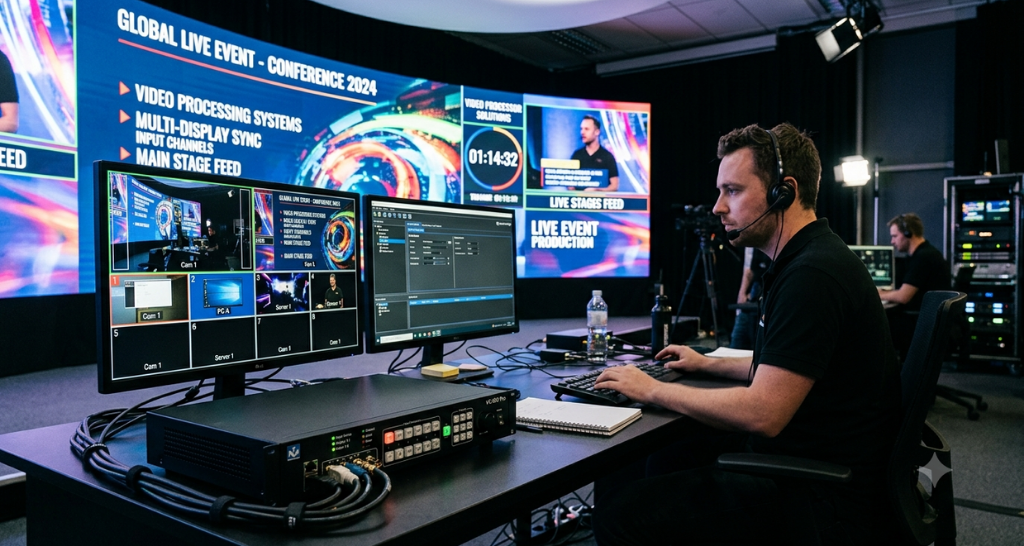
LED video walls have transformed the way businesses, entertainment venues, retail stores, auditoriums, command centers, and corporate offices communicate with their audiences. Their ability to deliver vibrant visuals, seamless content, and large-scale displays makes them one of the most effective digital display solutions available today. However, the exceptional performance of an LED video wall is not achieved by the display panels alone. Behind every flawless image is a LED Video Wall Video Processor that manages, optimizes, and distributes content across the entire screen.
A LED Video Wall Video Processor acts as the brain of an LED display system. It receives signals from various input sources, processes them, scales the resolution, adjusts image quality, and sends the optimized output to the LED display. Without this critical component, even the highest-quality LED panels cannot produce synchronized, distortion-free visuals.
Whether you’re deploying an Indoor LED Display for a corporate boardroom or an Outdoor LED Display for advertising, choosing the right processor is essential for achieving smooth playback, accurate colors, and reliable performance. Understanding how a LED Video Wall Video Processor works helps businesses invest in the right technology for long-term success.
What is a LED Video Wall Video Processor?
A LED Video Wall Video Processor is an advanced image-processing device that receives video signals from multiple input sources, processes the content, and delivers optimized output to an LED video wall. It ensures that images appear sharp, synchronized, and correctly scaled regardless of the screen size or content resolution.
Unlike a standard video switcher, a Video Processor for LED Display performs real-time image enhancement, color correction, resolution conversion, scaling, and signal management. It enables multiple content sources such as laptops, media players, CCTV cameras, live broadcasts, and conferencing systems to be displayed efficiently.
Modern LED Video Processor units support multiple input interfaces including HDMI, DisplayPort, DVI, VGA, SDI, and USB-C, making them compatible with a wide range of professional AV equipment.
How Does a LED Video Wall Video Processor Work?
The operation of a LED Video Wall Video Processor can be understood in five simple stages.
Step 1: Input Signal Reception
The processor receives signals from multiple devices such as:
- Laptop
- Desktop Computer
- Media Server
- CCTV Camera
- PTZ Camera
- Video Conferencing System
- Blu-ray Player
- Streaming Device
These signals may have different resolutions and frame rates.
Step 2: Signal Processing
This is where the LED Video Processor performs its most important functions.
It processes:
- Resolution Scaling
- Image Cropping
- Frame Synchronization
- Color Calibration
- HDR Processing
- Brightness Adjustment
- Contrast Enhancement
- Noise Reduction
This stage of Video Processing in LED Video Walls ensures that every image appears clear regardless of the original source.
Step 3: Resolution Mapping
Every LED display has a specific pixel resolution.
The Video Processor for LED Display maps incoming content to the exact LED screen resolution, preventing stretched or distorted images.
For example:
- Laptop Resolution → 1920 × 1080
- LED Wall Resolution → 3840 × 2160
The processor intelligently converts the content without affecting image quality.
Step 4: Output Distribution
After optimization, the LED Video Wall Video Processor sends processed signals to the sending card, which distributes data to receiving cards installed inside the LED cabinets and audio visual integration
Each cabinet receives its assigned image data, creating one seamless display.
Step 5: Real-Time Display
Finally, the LED modules display synchronized visuals with:
- Smooth motion
- Accurate colors
- Uniform brightness
- Sharp text
- High-definition images
This entire workflow happens within milliseconds, making Video Processing in LED Video Walls suitable for live events, conferences, sports venues, and command centers.
Signal Flow of an LED Video Wall System
The signal path typically follows this sequence:
Input Source → LED Video Wall Video Processor → Sending Card → Receiving Card → LED Cabinets → Complete LED Video Wall
Each stage ensures that content is processed accurately before appearing on the screen.
What Does a Video Processor Do?
A LED Video Wall Video Processor performs several critical tasks:
- Converts different video formats.
- Supports multiple input devices.
- Synchronizes LED cabinets.
- Enhances image quality.
- Adjusts colors and brightness.
- Reduces video latency.
- Supports Picture-in-Picture (PIP).
- Enables multi-window display.
- Provides seamless source switching.
- Optimizes large-format LED displays.
LED Video Wall Video Processor vs Standard Video Switcher
| Feature | LED Video Wall Video Processor | Standard Video Switcher |
|---|---|---|
| Resolution Scaling | ✔ Advanced | Limited |
| Color Calibration | ✔ Yes | No |
| HDR Support | ✔ Available | Rare |
| Multi-Window Display | ✔ Yes | Limited |
| LED Mapping | ✔ Yes | No |
| Image Optimization | ✔ Advanced | Basic |
| Picture-in-Picture | ✔ Supported | Limited |
| Large LED Wall Support | ✔ Designed for LED Walls | Not Optimized |
A dedicated Video Processor for LED Display is purpose-built to manage complex LED video wall installations, while a standard switcher mainly changes between video sources without advanced image processing.
Key Components of a Video Processor
A high-performance LED Video Wall Video Processor consists of multiple hardware and software components that work together to deliver exceptional image quality and seamless content management.
1. Input Interface Module
The input interface receives signals from multiple sources, including HDMI, DisplayPort, DVI, SDI, VGA, and USB-C devices. A professional Video Processor for LED Display supports multiple simultaneous inputs, making it suitable for conferences, live events, and command centers.
2. Image Processing Engine
This is the core of the LED Video Processor. It performs real-time image scaling, color correction, frame synchronization, HDR processing, deinterlacing, and image enhancement to ensure every frame appears crisp and accurate.
3. Scaling Engine
Different devices output different resolutions. The scaling engine converts incoming resolutions to match the native resolution of the LED wall without compromising image quality. Efficient Video Processing in LED Video Walls eliminates distortion and maintains aspect ratios.
4. Color Calibration System
Color consistency is essential for large-format displays. Advanced processors automatically calibrate brightness, white balance, gamma, and contrast, ensuring uniform visuals across every LED cabinet.
5. Multi-Window Controller
Many organizations need to display multiple sources simultaneously. A LED Video Wall Video Processor supports Picture-in-Picture (PiP), Picture-by-Picture (PbP), split-screen layouts, and customizable window arrangements.
6. Output Distribution Module
After processing, the processor sends optimized data to the sending card, which distributes signals to receiving cards installed inside each LED cabinet and Outdoor LED Display
Benefits of a LED Video Wall Video Processor
Investing in a professional LED Video Wall Video Processor offers significant advantages for businesses and organizations.
Superior Image Quality
A high-quality Video Processor for LED Display ensures sharp visuals, accurate colors, enhanced contrast, and smooth motion for every type of content.
Seamless Display Performance
Advanced Video Processing in LED Video Walls synchronizes multiple LED cabinets, eliminating tearing, flickering, and visible image inconsistencies.
Multiple Input Support
A single LED Video Processor can switch between laptops, media servers, cameras, and conferencing systems instantly, improving operational flexibility.
Improved User Experience
Centralized control simplifies content management, enabling operators to manage complex display systems with ease.
Future Scalability
Modern processors support higher resolutions such as 4K and 8K, allowing businesses to expand their LED video wall systems without replacing the entire processing infrastructure.
Reliable Performance
Professional processors are designed for continuous operation, making them suitable for mission-critical applications like control rooms, broadcast studios, and corporate command centers.
Facts & Figures
Understanding the capabilities of modern video processing technology helps businesses make informed investment decisions.
- Modern LED Video Processor units support resolutions up to 8K, enabling ultra-high-definition content on large LED walls.
- Premium processors can handle multiple input sources simultaneously, allowing operators to switch or display several content streams at once.
- Professional LED video wall systems can achieve refresh rates exceeding 3,840 Hz, delivering smooth visuals for live events and broadcast applications.
- High-quality LED displays paired with the right processor can offer an operational lifespan of up to 100,000 hours under typical usage conditions.
- Advanced Video Processing in LED Video Walls significantly reduces latency, making it suitable for real-time presentations, gaming events, and live productions.
Why Choose Lightomated for LED Video Wall Solutions?
At Lightomated, we understand that the performance of an LED video wall depends not only on the display panels but also on the processing technology behind them. Our team provides end-to-end solutions, from system design and processor selection to installation, calibration, and long-term support.
We also offer advanced display solutions through our Vivid Series for premium indoor environments and the Neo Series for applications requiring exceptional visual performance and reliability. Whether you’re planning a corporate boardroom, auditorium, retail store, or command center, Lightomated delivers customized LED display solutions that maximize performance and return on investment.