LED Module vs LED Cabinet: What’s the Difference?
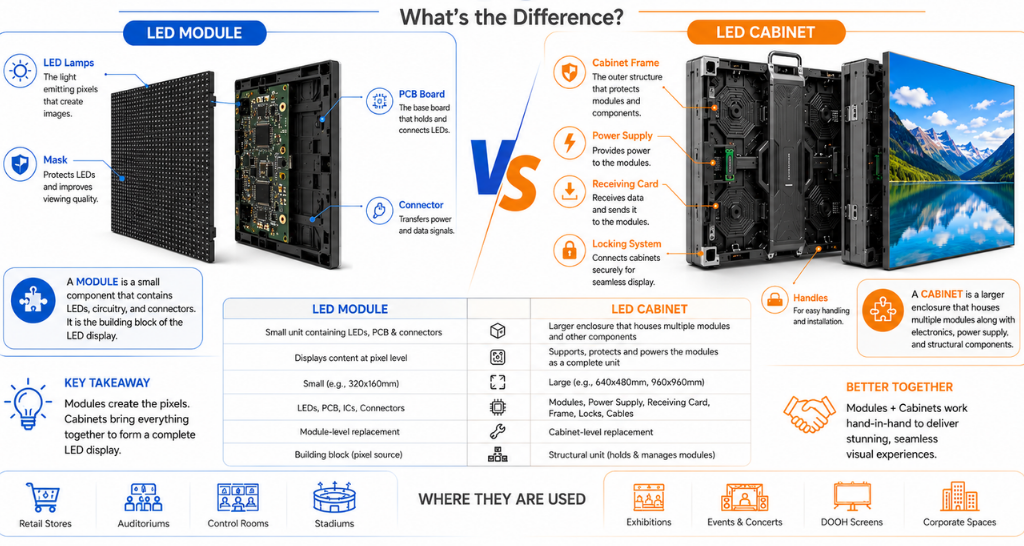
The performance of an LED video wall depends on much more than screen size or resolution. Behind every high-quality display is a combination of carefully engineered LED video wall components that work together to deliver seamless visuals, reliable performance, and long-term durability. Whether you’re installing a display in a corporate office, control room, retail space, auditorium, or broadcasting studio, understanding these components is essential before making an investment.
One of the most common questions buyers ask is: What is the difference between an LED display module and an LED display cabinet? Although these terms are often used interchangeably, they perform completely different functions within an LED video wall.
Choosing the wrong component or overlooking its role can result in uneven display quality, complicated maintenance, higher installation costs, and limited scalability. On the other hand, selecting the right LED video wall components ensures a reliable display that is easy to maintain, energy-efficient, and capable of delivering exceptional image quality for years.
What is an LED Display Module?
An LED display module is the smallest visual unit of an LED video wall. It contains hundreds or thousands of tiny LEDs mounted on a printed circuit board (PCB), which together create images, videos, and graphics.
Several LED display module units are assembled to form a larger display.
Main Features
- Houses RGB LEDs
- Contains driver ICs
- Designed for high image quality
- Available in different pixel pitches
- Easily replaceable during maintenance
The image quality of an LED video wall largely depends on the quality of the LED display module, making it one of the most critical LED video wall components.
What is an LED Display Cabinet?
An LED display cabinet is the structural frame that holds multiple LED modules together. It provides mechanical support, power distribution, data connectivity, and alignment for the display.
Unlike an LED module, the cabinet itself does not generate images. Instead, it acts as the backbone of the display system.
Main Functions
- Holds LED modules securely
- Protects internal electronics
- Supports power supplies
- Houses receiving cards
- Enables easy installation
- Maintains structural alignment
A high-quality LED display cabinet improves durability, simplifies maintenance, and ensures seamless panel alignment.
LED Display Module vs LED Display Cabinet :
Although both are essential LED video wall components, they serve completely different purposes.
| Feature | LED Display Module | LED Display Cabinet |
|---|---|---|
| Primary Function | Displays images | Supports and protects modules |
| Construction | PCB with LEDs | Aluminum or steel frame |
| Visibility | Visible display surface | Internal structural framework |
| Replacement | Individual module replacement | Cabinet replacement only if damaged |
| Weight | Lightweight | Heavier structural unit |
| Maintenance | Easy front/rear replacement | Provides maintenance access |
| Role | Creates visuals | Provides stability and connectivity |
Understanding this distinction helps organizations choose the right LED video wall components based on their application.
How Do LED Modules and Cabinets Works?
Think of an LED video wall like a building.
- The LED display cabinet is the building’s structure.
- The LED display module is the visible exterior.
- The power supply provides energy.
- The controller manages communication.
- The processor distributes content.
When assembled correctly, these LED video wall components create one seamless display capable of presenting high-resolution visuals.
Why Choosing the Right Components Matters?
Many buyers focus only on screen size and resolution, but ignoring the quality of internal LED video wall components can lead to long-term performance issues.
Benefits of Selecting the Right Components:
- Better display reliability
- Easier maintenance
- Longer operational lifespan
- Consistent brightness
- Improved color accuracy
- Reduced downtime
- Lower maintenance costs
Investing in premium LED video wall components ensures that the display continues performing efficiently even under continuous operation.
What Happens If You Choose the Wrong Components?
Selecting incompatible or low-quality components can negatively affect the performance of the entire display system.
1. Uneven Brightness
Inferior LED display module quality may result in visible brightness differences across the screen.
2. Frequent Maintenance
Poor-quality LED display cabinet construction can make servicing difficult and increase repair frequency.
3. Shorter Lifespan
Substandard components are more likely to fail, leading to increased maintenance costs and reduced system longevity.
4. Alignment Issues
Weak cabinet structures can cause visible gaps, affecting the seamless appearance of the display.
5. Higher Operational Costs
Frequent repairs and replacement of low-quality LED video wall components increase the total cost of ownership.
How LED Video Wall Components Work Together?
Every image displayed on an LED video wall follows a structured process.
Step 1 – Content Input
A laptop, media server, camera, or signage software sends content to the video processor.
Step 2 – Signal Processing
The processor adjusts the resolution and distributes the content to the sending card.
Step 3 – Data Transmission
The sending card transfers signals to receiving cards installed inside each LED display cabinet.
Step 4 – Module Activation
The receiving cards instruct every LED display module to illuminate specific LEDs, creating the final image.
Step 5 – Display Output
All LED video wall components work together to produce one seamless visual experience with high brightness, vibrant colors, and excellent image clarity.
Conventional Assembly vs Professionally Engineered LED Video Walls:
| Conventional Assembly | Professionally Engineered System |
| Generic components | Premium LED video wall components |
| Difficult maintenance | Front/rear service access |
| Inconsistent image quality | Uniform brightness and colors |
| Limited scalability | Modular expansion |
| Higher downtime | Reliable 24/7 performance |
| Manual alignment | Precision cabinet alignment |
For organizations investing in Indoor LED Video Walls, understanding the relationship between modules, cabinets, and other internal components is the foundation of choosing a reliable display solution.
Upgrade vs Don’t Upgrade
| Upgrade to Modern Components | Continue with Outdated Components |
|---|---|
| Uniform brightness | Uneven display quality |
| Easy module replacement | Time-consuming maintenance |
| Precision cabinet alignment | Visible gaps and misalignment |
| Lower power consumption | Higher operating costs |
| Better heat management | Increased risk of overheating |
| Longer lifespan | Frequent repairs |
| Higher reliability | Greater downtime |
| Easy future expansion | Limited scalability |
Investing in quality LED video wall components helps organizations reduce long-term costs while improving operational efficiency.
Facts & Figures
Modern LED display technology has evolved significantly over the last decade, making it one of the most reliable display solutions for commercial applications.
- High-quality LED displays can deliver an operational lifespan of up to 100,000 hours under normal conditions.
- Modular maintenance allows individual LED display modules to be replaced without dismantling the entire screen.
- Fine pixel pitch displays provide exceptional image clarity for close viewing distances.
- Die-cast aluminum LED display cabinets improve heat dissipation while reducing overall display weight.
- Advanced LED technology consumes less energy compared to many traditional large-format display systems while delivering superior brightness.
These advancements demonstrate why selecting premium LED video wall components is critical for long-term performance and return on investment.
How Lightomated Helps
At Lightomated, we understand that every LED video wall project has unique requirements. That’s why we provide complete consultation, system design, installation, and support services tailored to each application.
Our solutions include:
- Requirement analysis and site surveys
- Pixel pitch recommendations
- Selection of premium LED video wall components
- High-quality LED display module and cabinet solutions
- Professional installation and alignment
- Video processor configuration
- Testing and commissioning
- Preventive maintenance and AMC support
- Technical assistance across the project lifecycle
Our expertise in Video Wall Display solutions ensures every installation delivers outstanding image quality, reliability, and long-term performance. Combined with our experience in Audio Visual Integration, we create seamless display systems that meet the needs of corporate offices, control rooms, retail environments, auditoriums, and public spaces.
Whether you’re building a new LED video wall or upgrading an existing one, Lightomated helps you choose the right components to maximize performance, simplify maintenance, and protect your investment.