Sending Card Technology: How Content Reaches the LED Display
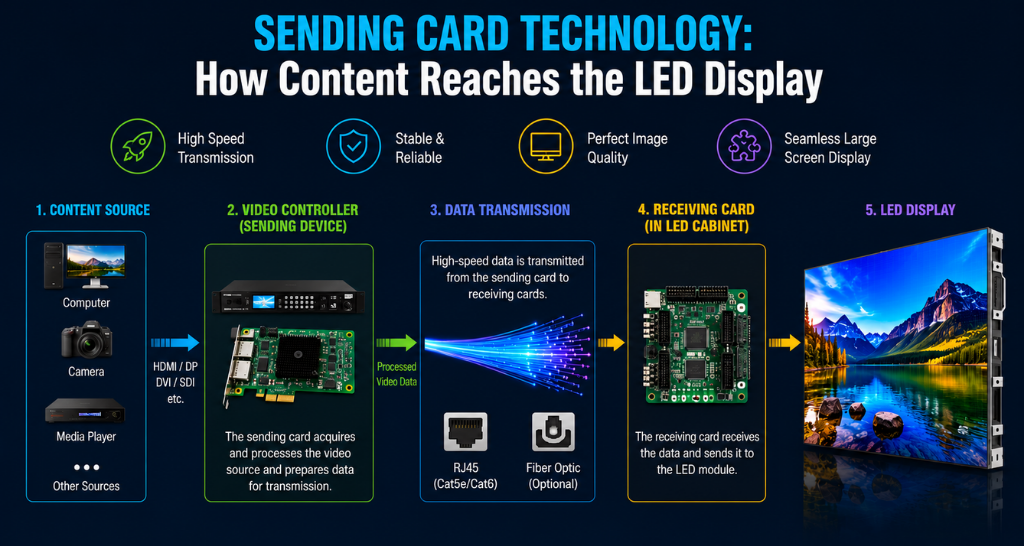
LED screens are not just displays they are intelligent visual systems powered by advanced control architecture. One of the most critical parts of this system is Sending Card Technology, which ensures that visual content is transmitted smoothly from a source device to the LED display.
Without this system, even the most advanced LED panels cannot function properly. In today’s digital environments like NOC, SOC, stadiums, and control rooms, Sending Card plays a key role in delivering real-time, high-quality visuals.
What is Sending Card Technology?
Sending Card Technology is a hardware component used in LED display systems that converts video signals into data signals and sends them to the receiving cards inside LED modules.
In simple terms, it acts as a bridge between the video source (like a computer, media player, or control system) and the LED screen.
The Sending Card in LED display ensures that every pixel receives accurate information in real time, maintaining display clarity and synchronization.
The LED display sending card function includes signal conversion, data distribution, and communication control between software and hardware layers.
The importance of Sending Card Technology cannot be ignored in modern LED systems. It ensures:
- Stable transmission of visual data
- Real-time content delivery
- High-resolution output without lag
- Synchronization across multiple LED panels
Without proper Sending Card Technology in LED display, screens may show delays, flickering, or image distortion.
How Does Sending Card Technology Work?
The working process of Sending Card Technology involves multiple steps that ensure smooth content delivery:
- The video source (computer or controller) generates content
- The sending card receives the video signal
- It converts the signal into LED-compatible data format
- Data is distributed to multiple receiving cards
- Each receiving card controls a section of the LED panel
- All panels sync together to form a complete image
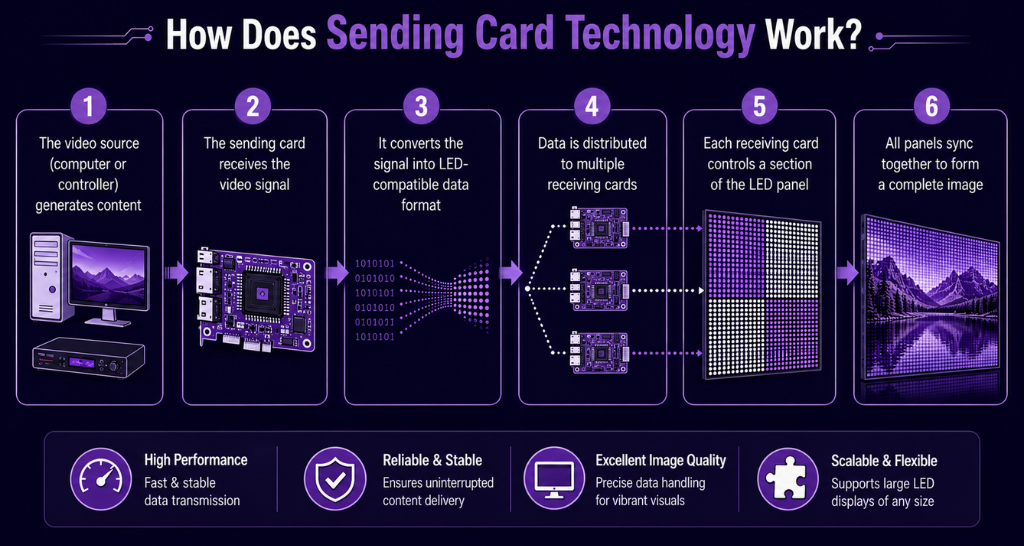
The LED display sending card function ensures that all data is transmitted in real time with zero or minimal latency.
The role of sending card in LED display becomes more important in large video walls where thousands of pixels must be controlled simultaneously.
Key Components of Sending Card Technology :
The system includes several important components:
- Input interface (HDMI, DVI, DP)
- Signal processor
- Memory buffer
- Output ports for LED data transmission
- Control software integration
Each part ensures that Sending Card Technology in LED display works efficiently under high load conditions.
The communication between sending card and receiving card is crucial for maintaining uniform brightness and color accuracy.
Benefits of Sending Card Technology
The advantages of Sending Card Technology are essential for modern LED display systems:
- Ultra-smooth video transmission
- Supports 4K and high-resolution content
- Reduces signal delay and latency
- Enables multi-screen synchronization
- Improves stability in 24/7 operations
- Supports remote monitoring and control
Facts & Figures
- Sending Card Technology can support millions of pixels per card
- Latency can be reduced to under milliseconds in advanced systems
- Supports multiple display configurations (video walls, curved displays, creative LED setups)
- Used in 90%+ of large-scale control room LED installations globally
The role of sending card in LED display is especially critical in environments like traffic control, defense monitoring, and enterprise SOC setups and Audio Visual Integration combines display, audio and control systems into one setup, enabling seamless communication, better collaboration and immersive experiences in modern spaces.
LED Receiving Card & Sending Card Flow
The difference between these two components is essential for understanding :
- Sending Card: Sends and processes video signals from the source
- Receiving Card: Receives data and controls individual LED modules
Together, they ensure smooth operation of the entire LED display system.
In Sending Card in LED display, both components must work in perfect synchronization for accurate output.
The LED display sending card function focuses on data distribution, while receiving cards focus on pixel-level control.
| Stage | Sending Card (Role in Flow) | Receiving Card (Role in Flow) |
|---|---|---|
| Signal Start | Takes video signal from source device (PC / processor) | Powers on with the system and becomes ready to receive data from the sending card |
| Processing | Converts input video into structured display data | Prepares to receive structured data |
| Data Transfer | Sends processed data to LED system network | Receives data from sending card |
| Distribution | Distributes full-screen data across multiple outputs | Splits and maps data to assigned LED module section |
| Control Level | Handles overall system communication | Controls pixel-level LED output |
| Final Output | Ensures correct data flow to receiving side | Displays final image on LED screen |
How Lightomated Helps in Sending Card Technology
Ligtomated provides advanced LED integration solutions where Sending Card Technology is optimized for performance, stability, and scalability.
Their systems ensure:
- Seamless integration with control rooms
- High-performance signal processing
- Reliable 24/7 display operation
- Custom LED configuration support
- Efficient content management systems
With expertise in Sending Card Technology in LED display, Vallect delivers solutions for NOC, SOC, smart cities, and enterprise command centers.