What Is a Remote Monitoring System for LED Displays and How Does It Work?
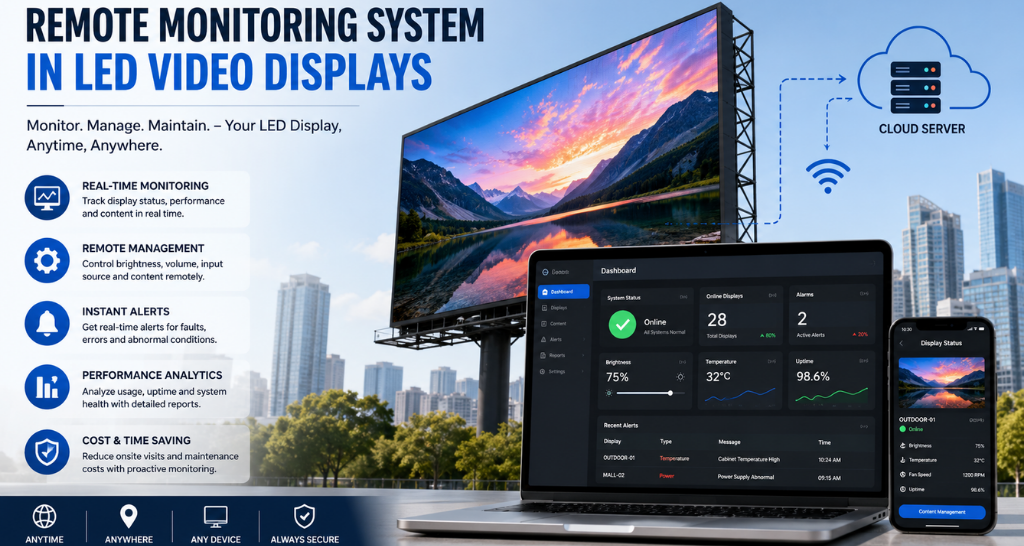
LED Video Displays have become an essential communication tool for businesses, educational institutions, retail stores, airports, corporate offices, stadiums, control rooms, and entertainment venues. These displays operate for long hours and often deliver mission-critical information, making consistent performance a top priority.
However, like any electronic system, LED displays require regular monitoring and maintenance to ensure they continue operating efficiently. Waiting until a display develops a visible issue can lead to downtime, expensive repairs, and poor audience experiences.
This is where a Remote Monitoring System becomes valuable. Instead of relying solely on manual inspections, organizations can monitor the health and performance of their LED displays in real time from virtually anywhere.
In this article, we’ll explain what a Remote Monitoring System is, how it works, what it monitors, and why it has become an important part of modern LED Video Displays.
What Is a Remote Monitoring System?
A Remote Monitoring System is a software and hardware solution that continuously tracks the operational status of LED Video Displays over a network. It collects performance data from the display, analyzes system health, and provides real-time updates through a centralized dashboard.
Rather than waiting for an Outdoor LED Display to fail, the remote monitoring system identifies potential problems early and notifies operators before they become major issues.
A remote monitoring platform enables maintenance teams to:
- Monitor display health remotely
- Detect hardware issues
- Receive instant alerts
- Track performance trends
- Reduce manual inspections
- Improve maintenance planning
This proactive approach significantly improves the reliability of LED Video Displays.
Why Is Remote Monitoring Important for LED Video Displays?
Many LED installations operate continuously throughout the day. Displays installed outdoors or across multiple locations are even more challenging to inspect manually and Remote Monitoring System.
Without continuous monitoring, organizations may not discover issues until customers or employees report them.
A Remote Monitoring System helps by:
- Reducing unexpected downtime
- Identifying faults before failure
- Improving display reliability
- Extending equipment lifespan
- Supporting preventive maintenance
- Lowering maintenance costs
Whether managing one Indoor LED Video Wall or hundreds of displays, remote monitoring makes maintenance more efficient and predictable.
How Does a Remote Monitoring System Work?
A Remote Monitoring System follows a simple but intelligent process.
1. Data Collection
Sensors and controllers inside the LED display constantly gather operational information.
Typical data includes:
- Cabinet temperature
- Power supply status
- Voltage
- Current
- Fan operation
- Brightness level
- Receiving card status
- Signal quality
- Network connectivity
This information is collected continuously without interrupting display performance.
2. Data Transmission
The collected information is securely transmitted to a central server through:
- Ethernet
- Wi-Fi
- 4G/5G
- Fiber network
- Cloud connectivity
This allows authorized users to access system information from any connected device.
3. Central Monitoring Dashboard
The monitoring software displays all collected information through a user-friendly dashboard.
Operators can quickly view:
- Online/offline displays
- Cabinet status
- System warnings
- Operating temperature
- Brightness settings
- Error history
- Maintenance records
The dashboard simplifies the management of multiple LED installations from a single location.
4. Intelligent Alerts
If the system detects abnormal conditions, it immediately sends alerts.
Common notifications include:
- High temperature
- Power supply failure
- Fan malfunction
- Communication loss
- Pixel abnormalities
- Receiving card failure
- Signal interruption
Alerts can be delivered through:
- SMS
- Mobile apps
- Web dashboards
This enables maintenance teams to respond much faster.
What Can Be Monitored in LED Video Displays?
Modern LED Display Monitoring systems track numerous performance parameters.
Temperature
Heat is one of the biggest threats to LED electronics.
Continuous temperature monitoring helps prevent:
- Component damage
- Reduced brightness
- Color inconsistency
- Premature hardware failure
Power Supply Status
Power supplies are essential for stable operation.
Monitoring helps detect:
- Voltage fluctuations
- Power loss
- PSU failure
- Electrical instability
Early detection minimizes display downtime.
Brightness Levels
Brightness directly affects image visibility.
The monitoring system checks whether brightness remains within the desired range.
Some systems integrated with Audio Visual Integration solutions automatically adjust brightness according to ambient lighting conditions, improving energy efficiency.
Cooling Fan Performance
Outdoor and high-brightness LED displays rely on cooling systems.
The platform monitors:
- Fan speed
- Fan operation
- Cooling efficiency
If a fan stops working, maintenance teams receive an immediate notification.
Receiving Card Status
Receiving cards process video signals for individual cabinets.
A Remote Monitoring System can identify:
- Communication errors
- Card failures
- Signal interruptions
This allows technicians to replace only the affected components instead of troubleshooting the entire display.
Signal Quality
Video signal interruptions may result from:
- Loose cables
- Damaged controllers
- Network issues
Monitoring systems continuously verify signal integrity to ensure uninterrupted content playback.
Network Connectivity
Many LED displays depend on stable network communication.
The monitoring platform identifies:
- Internet disconnections
- Router issues
- Controller communication errors
Quick detection keeps digital content running smoothly.
Benefits of Remote LED Display Management
Remote LED Display Management offers several operational and financial advantages.
Reduced Downtime
Continuous monitoring detects issues before they escalate, minimizing unexpected outages.
Faster Troubleshooting
Instead of manually inspecting every cabinet, technicians can pinpoint the exact location of the fault.
This significantly reduces repair time.
Lower Maintenance Costs
Preventive maintenance is generally less expensive than emergency repairs.
By identifying small issues early, organizations avoid costly component replacements.
Improved Display Performance
Maintaining optimal operating conditions helps ensure:
- Better image quality
- Consistent brightness
- Stable colors
- Reliable operation
Longer Equipment Life
Heat, electrical problems, and component failures gradually reduce LED lifespan.
Early detection minimizes wear and extends the life of the display.
Better Operational Efficiency
Organizations managing multiple LED displays can monitor every installation from one central platform.
This reduces travel, manual inspections, and maintenance effort.
Remote Monitoring vs Manual Inspection
| Feature | Remote Monitoring System | Manual Inspection |
| Real-time monitoring | Yes | No |
| Automatic alerts | Yes | No |
| Remote access | Yes | No |
| Predictive maintenance | Yes | Limited |
| Downtime reduction | High | Moderate |
| Maintenance efficiency | High | Lower |
| Multi-location management | Easy | Difficult |
Remote monitoring offers greater visibility and allows organizations to respond to issues much faster than traditional maintenance methods and Remote Monitoring System.
How Remote Monitoring Supports Smart LED Infrastructure ?
As LED technology becomes increasingly connected, remote monitoring is evolving beyond simple fault detection.
Modern systems can integrate with:
- Cloud-based management platforms
- IoT devices
- Building Management Systems (BMS)
- Energy monitoring tools
- Centralized AV control systems
This enables organizations to manage multiple digital assets from a unified interface, improving operational efficiency and reducing maintenance complexity.
How Lightomated Helps ?
At Lightomated, we provide advanced LED Video Displays designed for reliable, long-term performance. Our solutions support modern monitoring capabilities that help businesses oversee display health, identify potential issues early, and streamline maintenance across single or multiple locations and Remote Monitoring System.
From consultation and installation to ongoing technical support, our team helps organizations implement dependable LED display solutions tailored to their operational requirements.