Understanding SMD and COB Technology in LED Displays
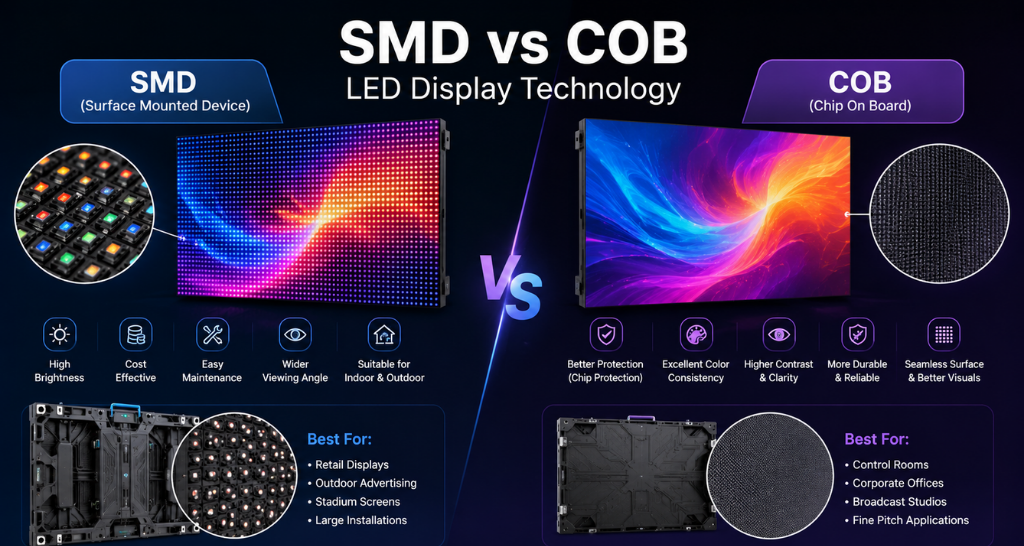
The demand for high-performance LED Displays has grown rapidly across corporate offices, retail stores, auditoriums, control rooms, studios, hospitality venues, and public spaces. Businesses today expect display solutions that deliver exceptional image quality, reliability, energy efficiency, and long-term performance. However, selecting the right display technology is no longer just about screen size or resolution it starts with understanding the technology behind the display itself.
Two of the most widely used technologies in modern LED Displays are SMD LED Display and COB LED Display. While both are designed to deliver vibrant visuals, they differ in construction, durability, viewing experience, maintenance, and application suitability.
As organizations continue upgrading their visual communication infrastructure, understanding LED Display Technology becomes essential for making informed investment decisions. Choosing the wrong display can lead to higher maintenance costs, reduced visual performance, and a shorter system lifespan.
This guide explains the differences between SMD and COB technologies, how they work, why businesses are upgrading, and what risks organizations face when continuing to use outdated display systems.
What is LED Display Technology?
LED Display Technology refers to digital display systems that use Light Emitting Diodes (LEDs) to produce images, videos, graphics, and dynamic content. Unlike conventional display technologies, LEDs generate light directly, delivering higher brightness, better contrast, and improved energy efficiency.
Modern LED Displays are modular, allowing multiple cabinets to be combined into one seamless display surface. This flexibility enables organizations to create customized display sizes for boardrooms, command centers, auditoriums, retail environments, and digital signage applications.
Today’s LED Displays are designed to operate continuously while maintaining consistent brightness, color accuracy, and performance, making them a preferred choice for professional installations.
Understanding SMD and COB Technology
Selecting between SMD and COB technology is one of the most important decisions when investing in LED Displays. Although both technologies are based on LEDs, they differ significantly in manufacturing methods and performance characteristics.
What is SMD Technology?
An SMD LED Display uses Surface Mounted Device technology, where red, green, and blue LED chips are mounted individually onto a PCB (Printed Circuit Board). These LEDs work together to create full-color images with excellent brightness and color reproduction.
SMD technology has been widely adopted because it offers:
- High color accuracy
- Wide viewing angles
- Multiple pixel pitch options
- Proven reliability
- Easy maintenance
It is commonly used in corporate offices, retail stores, conference rooms, educational institutions, and indoor advertising applications.
What is COB Technology?
A COB LED Display uses Chip-on-Board technology, where multiple LED chips are mounted directly onto the circuit board and covered with a protective resin layer.
Unlike traditional packaging methods, COB technology creates a smoother display surface with enhanced durability.
Key advantages include:
- Better physical protection
- Improved heat dissipation
- Reduced glare
- Higher resistance to dust and moisture
- Enhanced durability for demanding environments
COB technology is increasingly preferred for applications where display reliability and close-viewing performance are critical.
How Do SMD and COB LED Technologies Work?
Although both technologies produce high-quality visuals, their manufacturing process differs significantly.
SMD Technology Working
In SMD displays:
- Individual RGB LED packages are manufactured separately.
- Each package is mounted onto the PCB.
- Thousands of LEDs combine to create images.
- The display is calibrated for brightness and color consistency.
This process provides flexibility and excellent image quality across different screen sizes.
COB Technology Working
In SMD & COB LED comparison, COB follows a different manufacturing process.
Instead of placing individual packaged LEDs, multiple LED chips are mounted directly onto the PCB and encapsulated under a protective coating.
This results in:
- Better structural strength
- Improved thermal performance
- Reduced risk of LED damage
- Higher display reliability
Because the LEDs are protected, COB displays require less maintenance in high-usage environments and Audio Visual Integration.
Why Businesses Are Upgrading Their LED Displays?
Technology continues to evolve, and organizations are replacing older display systems with modern LED Displays to improve communication, operational efficiency, and customer engagement.
Better Image Quality
Modern LED Displays deliver sharper visuals, richer colors, and higher contrast, making presentations, advertisements, and operational dashboards easier to view.
Lower Maintenance
New-generation display technologies reduce maintenance requirements and improve overall system reliability.
Energy Efficiency
Today’s LED Displays consume less power while delivering higher brightness than many older display technologies.
Longer Operational Life
Businesses investing in advanced LED Displays benefit from longer operational lifespans and reduced replacement costs.
Improved User Experience
Whether used in meeting rooms, retail environments, or control centers, upgraded displays improve audience engagement and operational efficiency.
What Happens If You Don’t Upgrade?
Many organizations continue using outdated display systems because they appear to function adequately. However, delaying upgrades can lead to several operational challenges.
Reduced Visual Performance
Older displays often experience lower brightness, inconsistent colors, and reduced image clarity, making content difficult to read.
Higher Maintenance Costs
As display components age, maintenance becomes more frequent and more expensive.
Increased Downtime
Unexpected failures can interrupt meetings, operations, or customer experiences, leading to productivity losses.
Limited Scalability
Legacy display systems are difficult to expand, making future upgrades more expensive.
Higher Energy Consumption
Older technologies generally consume more electricity while delivering lower visual performance.
Investing in modern LED Displays helps organizations overcome these limitations while creating future-ready communication environments.
SMD vs COB: Which Technology is Better?
| Feature | SMD Technology | COB Technology |
| Manufacturing | Individual packaged LEDs | LED chips mounted directly on PCB |
| Surface Protection | Standard | Higher protection |
| Heat Dissipation | Good | Excellent |
| Maintenance | Easy module replacement | Lower maintenance requirements |
| Durability | High | Very High |
| Close Viewing Experience | Excellent | Superior |
| Physical Resistance | Moderate | Better resistance to impact and dust |
There is no universal “best” option. The right choice depends on viewing distance, installation environment, budget, maintenance expectations, and application requirements.
For most professional installations, selecting the appropriate technology ensures that LED Displays deliver long-term reliability, exceptional image quality, and maximum return on investment.
Key Components Behind Modern LED Displays:
The performance of modern LED Displays depends on more than just SMD or COB technology. A complete LED solution combines multiple hardware and software components that work together to deliver reliable visuals, smooth content playback, and long-term performance.
1. LED Modules
LED modules are the building blocks of LED Displays. They contain the LEDs responsible for producing images and videos. Multiple modules are assembled to create displays of different sizes and resolutions.
2. LED Cabinets
Cabinets provide the structural framework for mounting LED modules. They ensure proper alignment, stability, ventilation, and easy maintenance.
3. Video Processor
A video processor receives signals from laptops, media players, cameras, or control systems and optimizes them before displaying the content. It manages scaling, switching, image synchronization, and color calibration.
4. Sending & Receiving Cards
These components transmit and distribute data across every LED cabinet, ensuring synchronized content without lag or distortion.
5. Power Supply Units
Stable power distribution is essential for uninterrupted performance. Modern power supplies improve efficiency while protecting the display from voltage fluctuations.
6. Control Software
LED control software allows users to schedule content, monitor display performance, adjust brightness, and manage multiple screens from a centralized platform.
Benefits of Upgrading to Modern LED Displays:
Organizations upgrading their LED Displays experience significant operational and financial advantages.
Superior Visual Quality
Modern LED Displays provide vibrant colors, deeper contrast, and exceptional brightness, ensuring clear visibility even in challenging lighting conditions.
Improved Reliability
New-generation display technologies are designed for continuous operation, making them suitable for corporate environments, retail spaces, command centers, and public venues.
Lower Maintenance Costs
Enhanced manufacturing techniques and durable components reduce maintenance requirements and minimize downtime.
Better Energy Efficiency
Compared to many older display technologies, modern LED Displays consume less power while delivering higher brightness and improved image quality.
Flexible Installation
The modular design of LED Displays allows businesses to create custom screen sizes and configurations that match their available space and operational needs.
Future Scalability
As business requirements evolve, additional cabinets can be integrated without replacing the existing system, protecting long-term investment.
Where Are LED Displays Used?
Modern LED Displays are used across multiple industries where reliable visual communication is essential.
- Corporate offices
- Retail stores
- Shopping malls
- Auditoriums
- Conference rooms
- Educational institutions
- Museums
- Airports
- Railway stations
- Hospitality venues
- Broadcast studios
- Control rooms
- Entertainment venues
Each application has unique requirements, making the selection of the right display technology an important part of the project planning process.
Facts & Figures:
The adoption of LED Displays continues to grow as organizations invest in digital transformation and immersive visual communication.
- High-quality LED solutions can provide an operational lifespan of up to 100,000 hours under typical usage conditions.
- Modern LED technology offers wider viewing angles, making content clearly visible from different positions.
- Fine-pixel displays improve close-viewing experiences for corporate and indoor applications.
- Energy-efficient LED systems help reduce long-term operational costs compared to many legacy display technologies.
- Modular architecture allows organizations to expand display size without replacing the complete installation.
These advantages make LED Displays a long-term investment for businesses seeking performance, reliability, and scalability.
How Lightomated Helps?
Choosing between SMD and COB technology requires technical expertise, application knowledge, and careful planning. Lightomated helps organizations identify the most suitable solution based on viewing distance, environment, usage requirements, and budget.
Our end-to-end services include:
- Consultation and requirement analysis
- Site survey and technical assessment
- Display size and pixel pitch recommendations
- Technology selection (SMD or COB)
- Custom system design
- Professional installation
- Calibration and testing
- User training
- Preventive maintenance and AMC support
- Pan-India deployment
Whether you’re planning an Indoor LED Video Wall for a corporate boardroom or an Outdoor LED Video Wall for advertising and public communication, our team ensures every project is designed for maximum performance and reliability.
We also provide complete Audio Visual Integration services, enabling seamless connectivity between displays, conferencing systems, control solutions, and other AV technologies. To support dynamic visual communication, Lightomated designs and installs customized Video Wall Display solutions tailored to your business requirements.