How LED Video Wall Signal Flow Works: From Input Source to Display Output
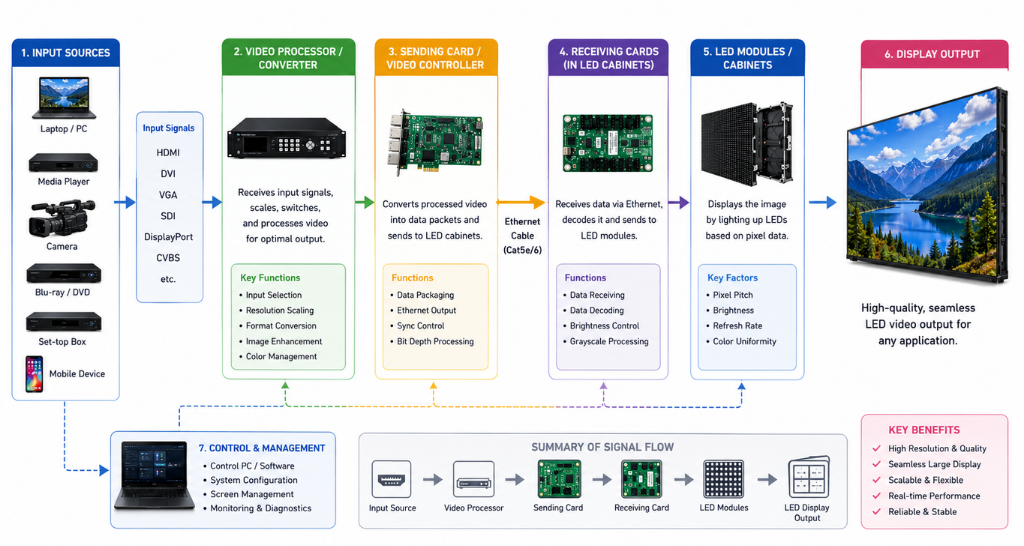
Modern digital communication relies heavily on visual presentation technologies, and the LED Video Wall has become one of the most powerful display solutions available today. Whether installed in corporate command centers, airports, stadiums, shopping malls, educational institutions, or control rooms, LED walls deliver vibrant visuals, seamless scalability, and exceptional brightness.
However, many users focus only on the display itself and overlook the technology operating behind the scenes. Understanding the LED video wall signal flow is essential for ensuring optimal performance, image quality, and system reliability. Every image shown on an LED wall follows a complex path from the content source to the display screen.
This article explains the complete LED display input to output process, explores the components involved, and highlights how a modern video wall signal processing system manages content efficiently. By understanding this workflow, organizations can design more effective and reliable LED Video Wall installations.
What is LED Video Wall Signal Flow?
The LED video wall signal flow refers to the sequence of processes that transfer visual content from an input source to the LED display surface.
In a typical setup, content originates from a source device such as:
- Computer
- Media player
- CCTV system
- Broadcast equipment
- Presentation system
- Video conferencing platform
The signal then travels through a video wall signal processing system, where it is processed, optimized, and distributed before reaching the LED cabinets.
The complete LED display input to output process includes:
- Input Source
- Signal Switching
- Video Processing
- Sending Controller
- Receiving Cards
- LED Modules
- Final Visual Output
Each stage contributes to maintaining image quality, synchronization, and overall performance of the LED Video Wall and Audio Visual Technologies integrate advanced sound, video, and control systems to deliver immersive communication experiences in education, corporate events, and live productions.
Why LED Video Wall Signal Flow Important ?
A properly designed LED video wall signal flow is critical for delivering smooth and reliable visual experiences.
Ensures High Image Quality
The signal processing chain helps maintain color accuracy, brightness consistency, and image sharpness across the entire LED Video Wall.
Supports Multiple Content Sources
Modern facilities often require content from multiple systems simultaneously. A sophisticated video wall signal processing system enables seamless switching between different inputs.
Reduces Latency
Real-time environments such as control rooms and broadcasting facilities depend on minimal delay. An optimized LED display input to output process ensures rapid signal transmission.
Improves System Reliability
Proper signal management minimizes display interruptions, synchronization issues, and communication errors between components.
Enables Scalability
As organizations expand their visual communication requirements, a structured LED video wall signal flow makes future upgrades easier and more cost-effective.
Applications and Components of LED Video Wall Signal Flow
1. Input Sources
Every LED Video Wall begins with content generation.
Common input sources include:
- Desktop computers
- Laptops
- Digital signage players
- Security cameras
- Video conferencing systems
- Live streaming equipment
- Television broadcast systems
These devices generate the video signal that enters the video wall signal processing system.
Signal Formats
Typical signal formats include:
- HDMI
- DisplayPort
- DVI
- SDI
- USB-C
- IP-based video streams
The first step of the LED display input to output process involves converting these signals into formats suitable for LED wall transmission.
2. Matrix Switchers and Signal Distribution
Organizations often need multiple content sources displayed on the same LED Video Wall.
Matrix switchers perform several functions:
- Source selection
- Signal routing
- Multi-source management
- Display zoning
- Input prioritization
These devices act as traffic controllers within the LED video wall signal flow.
For example, a control room may switch between:
- CCTV feeds
- GIS maps
- Dashboard analytics
- Live news channels
without interrupting display operations.
3. Video Wall Processor
The video wall processor is the core of the video wall signal processing system.
Its primary responsibilities include:
Signal Scaling
Adjusts incoming content to match wall resolution.
Image Enhancement
Improves:
- Brightness
- Contrast
- Color balance
- Sharpness
Window Management
Allows multiple content windows to appear simultaneously.
Content Layout
Creates custom display arrangements across large LED Video Wall installations.
Advanced processors can support:
- Picture-in-picture
- Multi-window display
- Dynamic content layouts
- Real-time content manipulation
This stage is one of the most important steps in the LED display input to output process.
4. Sending Controller
After processing, the signal reaches the sending controller.
The sending controller acts as the bridge between the processor and the LED wall.
Functions include:
- Data transmission
- Signal conversion
- Synchronization
- Resolution mapping
The controller converts video information into a format understandable by LED receiving cards.
In large-scale LED Video Wall deployments, multiple sending controllers may be used to manage massive display resolutions.
5. Receiving Cards
Receiving cards are installed inside LED cabinets.
They receive data from the sending controller and distribute it to individual LED modules.
Responsibilities include:
- Data decoding
- Pixel mapping
- Brightness calibration
- Refresh rate control
Receiving cards play a vital role in maintaining the integrity of the LED video wall signal flow.
Any issue at this stage can affect image quality across the display.
6. LED Modules and Cabinets
LED modules are the visible display units that make up the entire LED Video Wall.
Each module contains thousands of LEDs arranged in a precise grid.
The receiving cards deliver image data to these modules, which illuminate specific LEDs according to incoming instructions.
This stage represents the final hardware portion of the LED display input to output process.
Modern LED cabinets offer:
- High refresh rates
- Fine pixel pitches
- HDR support
- Superior brightness control
7. Display Output
The final stage of the LED video wall signal flow is image presentation.
Once the data reaches the modules, the LEDs illuminate in precise patterns to create:
- Images
- Videos
- Dashboards
- Live feeds
- Advertisements
- Presentations
The audience sees a seamless visual experience without noticing the extensive processing occurring behind the scenes.
Impact of Efficient LED Video Wall Signal Flow :
| S.No. | Parameter | Advantages (Efficient) | Disadvantages (Poor) |
| 1 | Visual Quality | Vibrant and smooth visuals. | Flickering and blurry screen. |
| 2 | Operations | Real-time accurate data display. | Lag and delayed data. |
| 3 | Management | Automated and easy routing. | Hard manual troubleshooting required. |
| 4 | Content | Multiple sources display simultaneously. | Limited to single source. |
| 5 | System Health | Minimal hardware and signal errors. | Frequent screen blackouts. |
A well-designed LED video wall signal flow delivers significant operational benefits.
Enhanced Viewer Experience
High-quality signal processing ensures vibrant and immersive visual content.
Improved Decision-Making
Control rooms benefit from real-time information displayed accurately across the LED Video Wall.
Greater Operational Efficiency
Automated signal routing reduces manual intervention and simplifies system management.
Better Content Flexibility
Organizations can display multiple content sources simultaneously using a modern video wall signal processing system.
Reduced Maintenance Issues
Proper system architecture minimizes communication errors and hardware failures.
The efficiency of the LED display input to output process directly influences overall display performance.
How Lightomated Ensures Seamless Signal Flow and Display Performance
Lightomated delivers comprehensive LED Video Wall solutions designed to meet the requirements of modern communication environments.
Our services include:
- System design and consultation
- Signal flow planning
- Video processor integration
- Controller configuration
- Display calibration
- Content management integration
- Testing and commissioning
- Maintenance and support
By carefully designing the LED video wall signal flow, Lightomated ensures reliable performance, superior image quality, and seamless operation across all project sizes.
Our experts optimize every stage of the LED display input to output process, helping organizations maximize their technology investments.
Lightomated has successfully deployed LED Video Wall solutions across diverse sectors including:
- Corporate offices
- Command and control centers
- Educational institutions
- Transportation hubs
- Retail environments
- Government facilities
- Event venues
In a recent command center deployment, the organization required simultaneous monitoring of surveillance feeds, operational dashboards, and communication platforms.
Our team designed a customized video wall signal processing system capable of handling multiple high-resolution inputs while maintaining real-time performance. The optimized LED video wall signal flow enabled seamless source switching, reduced latency, and improved operator efficiency.
The result was a highly reliable visualization platform that enhanced situational awareness and decision-making capabilities.