Why Are Museum Visitors Leaving Early: Display Challenges and How LED Video Walls Help?
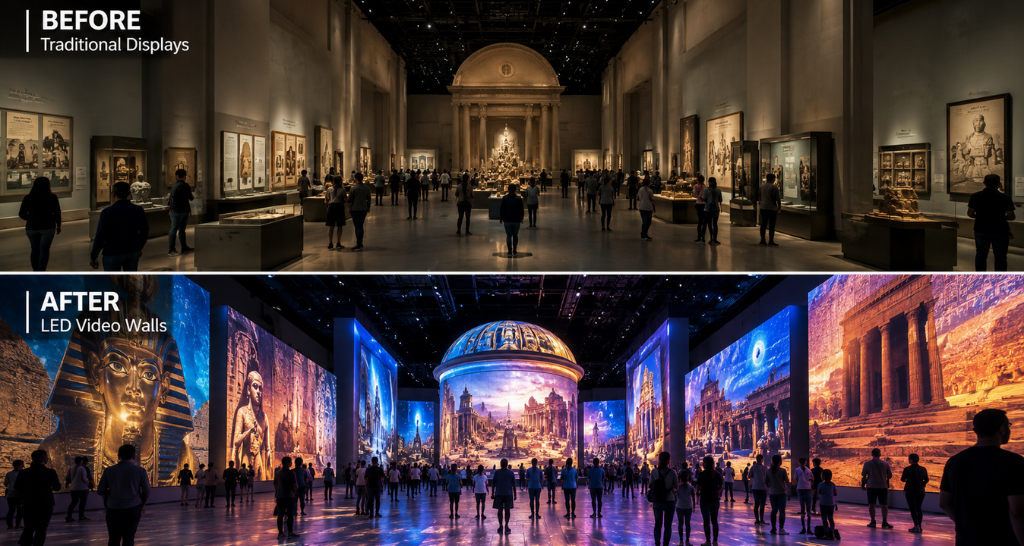
It was a Saturday afternoon, and the museum looked busy from the outside. School groups were arriving, families were taking photos at the entrance, and visitors were excited to explore what was waiting inside. Everything suggested a great day ahead.
But inside, something else was happening.
A family stopped at an exhibit for less than thirty seconds before walking away. A student group looked interested initially, but attention shifted to phones within minutes. A couple skipped multiple sections entirely and headed directly toward the exit. By evening, the museum management noticed a pattern they had been seeing for months: people were entering with curiosity but leaving much earlier than expected.
LED Video Walls transform museum experiences by creating immersive visuals, interactive storytelling, and better visibility, helping increase visitor engagement and reduce early exits.
The question wasn’t whether visitors were coming.
The real question was why they weren’t staying.
For many museums, visitor retention has quietly become a challenge. Curators spend months designing experiences, historians carefully build narratives, and teams invest heavily in creating educational journeys. Yet many visitors leave without completing the experience.
The issue often isn’t the collection itself.
It’s how the story is being delivered.
The Hidden Display Problem Many Museums Face
Modern visitors live in a world surrounded by visual interaction. People use smartphones, immersive media platforms, high-quality screens, and interactive content every day. When they walk into a museum and encounter static displays with limited engagement, the experience can feel disconnected.
Common museum challenges often include:
- Low visitor engagement in exhibit areas
- Difficulty keeping younger audiences interested
- Poor visibility in large spaces
- Static content that rarely changes
- Limited storytelling possibilities
- Uneven brightness across exhibits
- Lack of interactive experiences
Many museums realize that traditional display methods struggle to match modern expectations.
This is where advanced museum display technology starts changing the experience.
Before: The Visitor Experience Problem
Imagine entering a historical section in a museum.
There are artifacts inside glass cases, some printed descriptions on walls, and a projector playing content in a corner.
Initially, visitors feel interested.
Five minutes later:
People move quickly from one exhibit to another.
Children lose interest because the presentation feels passive.
Large crowds block visibility.
Important details become difficult to notice.
The emotional connection disappears.
Museums often think visitors are leaving because of shorter attention spans.
But visitors regularly spend hours watching engaging experiences elsewhere.
The issue is often presentation rather than attention.
Traditional systems sometimes struggle to create a continuous journey that keeps visitors involved from beginning to end.
Many institutions now explore museum display solutions that transform static environments into engaging storytelling spaces.
Why Display Experience Matters More Than Ever
Museums today are not only educational spaces.
They are experience destinations.
Visitors expect:
- Dynamic storytelling
- Interactive content
- Visual immersion
- Easy understanding of information
- Personalized experiences
- Social-media-friendly environments
Without these elements, even valuable exhibits can feel disconnected.
Modern museum display technology helps bridge the gap between information and experience.
And one technology is becoming increasingly important.
How LED Video Walls Change Museum Experiences
Think about entering a museum where ancient civilizations appear to move around you. Imagine walking through a space exhibit where galaxies slowly rotate across massive digital surfaces. Imagine wildlife museums where forests feel alive with movement and sound.
This is where LED Video Walls create a major difference.
Rather than simply displaying content, LED Video Walls build immersive environments that hold attention naturally.
Visitors stop.
Watch.
Interact.
And remain engaged for longer periods.
Instead of asking people to imagine stories, the display helps them experience them.
After: What Changes with LED-Based Museum Experiences
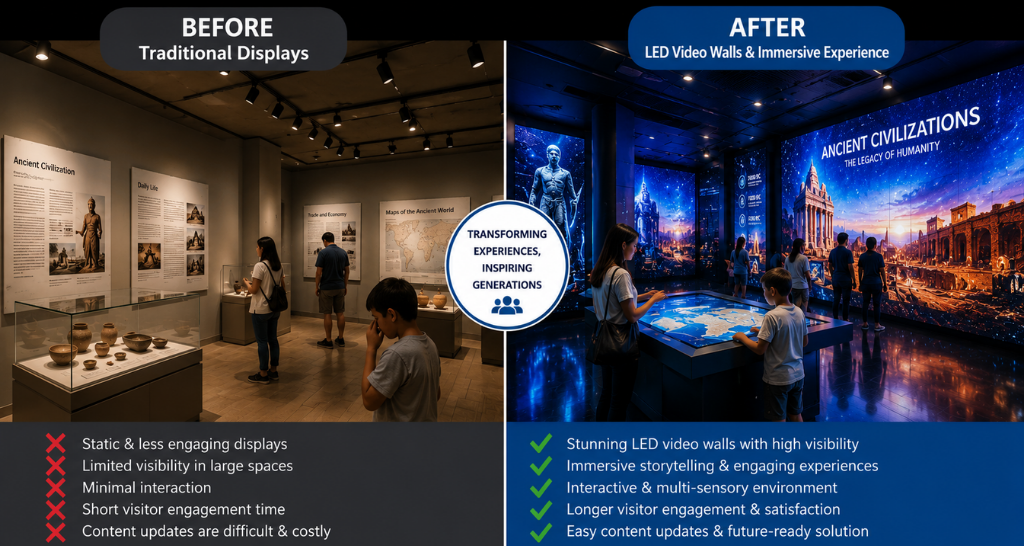
Let’s revisit the same museum.
This time visitors enter a redesigned exhibit space.
As they walk in, large LED Video Walls introduce the story visually. Historical events unfold through motion graphics. Animated timelines guide visitors naturally. Digital environments surround them.
Children point toward moving content.
Students stop to discuss exhibits.
Families spend more time in each section.
People begin taking photos and sharing experiences online.
The journey changes completely.
The difference is not just appearance.
The difference is engagement.
Ways LED Video Walls Solve Museum Challenges
1. Better Visual Impact
Traditional displays can sometimes struggle in large environments where visibility becomes difficult.
Large LED Video Walls ensure that information remains visible across wider viewing angles and larger spaces.
Visitors do not need to stand in one specific location.
Everyone can experience content clearly.
2. Stronger Storytelling Experiences
Museums are built around stories.
Static presentations often limit how stories can be told.
LED Video Walls help museums combine:
- Motion graphics
- Historical recreations
- Interactive content
- Visual narratives
- Multimedia presentations
Storytelling becomes more engaging and easier to understand.
This is why many institutions are investing in LED Video Walls for Museums to improve visitor experiences.
3. Flexible Content Updates
Printed materials and traditional displays often require time and cost for modifications.
With LED Video Walls, content updates become much easier.
Museums can:
- Add temporary exhibitions
- Change seasonal themes
- Update educational information
- Create event-based content
- Introduce interactive campaigns
Modern museum display solutions allow museums to stay flexible.
4. Encouraging Visitor Interaction
People remember experiences more than information.
Interactive environments encourage visitors to participate rather than simply observe.
Touch-enabled systems, motion-based interactions, and digital storytelling combined with LED Video Walls for Museums create memorable experiences.
Visitors spend more time exploring.
Longer engagement often translates into higher satisfaction.
5. Creating Shareable Moments
Today’s visitors frequently share experiences online.
Immersive displays naturally create photo opportunities.
Large LED Video Walls often become visual attractions within museums themselves.
This creates additional visibility for institutions through social sharing and visitor-generated content.
Why Museums Are Moving Toward Advanced Display Solutions
Museums are no longer competing only with other museums.
They compete with:
- Entertainment spaces
- Interactive attractions
- Digital experiences
- Educational technology platforms
Visitors expect engagement everywhere.
This shift is driving demand for museum display technology that supports immersive environments.
Many museums are increasingly adopting LED Video Walls for Museums because they help connect information with experience.
The Role of Audiovisual Integration
Display technology alone does not create complete experiences.
Successful museums combine visual systems with audio, controls, and interactive platforms.
Integrated audiovisual solutions for museums help create seamless visitor journeys.
These systems may include:
- Directional audio systems
- Interactive kiosks
- Digital signage
- Projection mapping
- Control systems
- Immersive display environments
When integrated correctly, audiovisual solutions for museums make technology feel invisible while making experiences feel natural.
Creating Future-Ready Museums
Museums continuously evolve.
Exhibitions change.
Audience expectations change.
Technology changes.
Investing in adaptable museum display solutions allows institutions to remain prepared for future needs.
Scalable systems provide flexibility without requiring complete redesigns every few years.
Modern museum display technology supports long-term growth and evolving visitor expectations.
The Real Goal Isn’t Screens
Many people assume museums are adding technology simply because it looks modern.
That isn’t the real objective.
The purpose is connection.
Visitors want to feel something.
They want to understand history, science, art, and culture in ways that feel relevant.
Technology should support that goal.
When implemented correctly, LED Video Walls do not replace museum stories.
They help those stories become more visible, memorable, and immersive.
The result isn’t simply a better display.
The result is visitors staying longer, engaging deeper, and leaving with experiences they remember.