NOC vs SOC Rooms: Understanding the Technology Differences
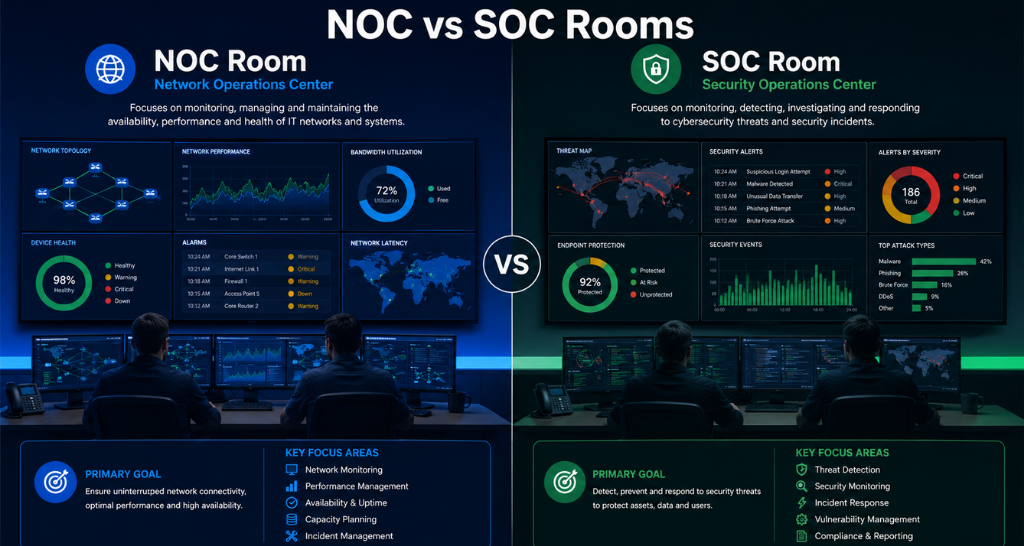
As organizations continue to expand their digital infrastructure, the need for dedicated monitoring and security operations has become more important than ever. In NOC vs SOC Rooms, businesses rely on advanced operational centers to ensure network performance, system availability, cybersecurity protection, and regulatory compliance. Two critical facilities that play a major role in modern IT operations are the Network Operations Center and the Security Operations Center.
Although these centers often work together, they serve different purposes. Understanding the NOC vs SOC Rooms debate is essential for enterprises looking to optimize operations, reduce downtime, and strengthen cybersecurity defenses.
A NOC focuses on network health, system performance, uptime, and operational continuity. In contrast, a SOC concentrates on threat detection, incident response, cybersecurity monitoring, and risk mitigation and Indoor video walls deliver high-resolution visuals for control rooms, offices, retail, and meeting spaces with seamless display performance.
This guide explores the technology, architecture, working mechanisms, components, benefits, and key distinctions between NOC and SOC rooms while helping organizations determine which solution best fits their operational needs.
What is a NOC Room?
A Network Operations Center (NOC) is a centralized location where IT professionals monitor, manage, and maintain network infrastructure and system performance.
The primary objective of a NOC is to ensure uninterrupted network operations by identifying and resolving issues before they impact users or business processes and Audio visual integration combines displays, sound, and control systems to create seamless communication and collaboration experiences.
.
NOC teams are typically responsible for keeping systems operational 24/7 and minimizing downtime.
What is a SOC Room?
A Security Operations Center (SOC) is a centralized facility dedicated to monitoring, detecting, analyzing, and responding to cybersecurity threats.
SOC analysts continuously monitor security events across networks, endpoints, cloud environments, and applications to identify suspicious activity and Outdoor video walls provide bright, durable, and weather-resistant display solutions for advertising, events, and public environments.
Unlike a NOC, a SOC is primarily concerned with protecting organizational assets from cyberattacks and data breaches.
| Key Responsibilities of NOC | Key Responsibilities of SOC |
|---|---|
| Monitoring network performance | Threat monitoring |
| Managing servers and applications | Security incident response |
| Detecting outages and failures | Malware analysis |
| Ensuring uptime and availability | Vulnerability management |
| Capacity planning | Security event correlation |
| Performance optimization | Compliance monitoring |
| Infrastructure maintenance | Threat intelligence integration |
How Does a NOC Work?
A NOC continuously collects operational data from various infrastructure components.
Monitoring Process
- Data Collection
- Performance Analysis
- Alert Generation
- Issue Identification
- Resolution and Escalation
- Reporting and Optimization
Technologies Used
- Network Monitoring Systems
- SNMP Monitoring
- Performance Analytics Platforms
- Server Monitoring Tools
- Infrastructure Management Software
- Visualization Dashboards
NOC engineers analyze alerts related to:
- Network latency
- Packet loss
- Server outages
- Bandwidth utilization
- Hardware failures
The goal is maintaining service availability.
How Does a SOC Work?
A SOC gathers security-related data from multiple sources and analyzes it for potential threats.
Security Workflow
- Log Collection
- Event Correlation
- Threat Detection
- Investigation
- Incident Response
- Recovery and Reporting
Technologies Used
- SIEM Platforms
- Threat Intelligence Tools
- Endpoint Detection and Response (EDR)
- Firewalls
- IDS/IPS Systems
- Security Analytics Platforms
SOC analysts investigate:
- Malware infections
- Unauthorized access attempts
- Data exfiltration
- Insider threats
- Ransomware attacks
- Phishing incidents
The goal is protecting the organization’s digital environment.
NOC vs SOC Rooms: Understanding the Technology Differences
The primary distinction in NOC vs SOC Rooms lies in their operational focus.
| Feature | NOC | SOC |
|---|---|---|
| Primary Focus | Network Performance | Cybersecurity |
| Objective | Uptime & Availability | Threat Prevention |
| Monitors | Infrastructure & Systems | Security Events |
| Teams | Network Engineers | Security Analysts |
| Alerts | Performance Issues | Security Threats |
| Key Metrics | Latency, Uptime, Bandwidth | Threats, Incidents, Vulnerabilities |
| Tools | NMS, Server Monitoring | SIEM, EDR, Threat Intelligence |
| Response | Fix Technical Issues | Mitigate Security Risks |
| Reporting | Operational Health | Security Posture |
| Business Impact | Reduces Downtime | Prevents Breaches |
NOC & SOC Technology Differences in Monitoring Infrastructure
The NOC SOC technology differences become more evident when analyzing monitoring architecture.
NOC Monitoring Sources
- Routers
- Switches
- Servers
- Databases
- Applications
- Cloud Infrastructure
SOC Monitoring Sources
- Security Logs
- Firewall Logs
- Endpoint Activity
- Authentication Systems
- Threat Feeds
- Cloud Security Events
The NOC SOC technology differences influence the tools, workflows, dashboards, and operational priorities of each center.
Facts and Figures
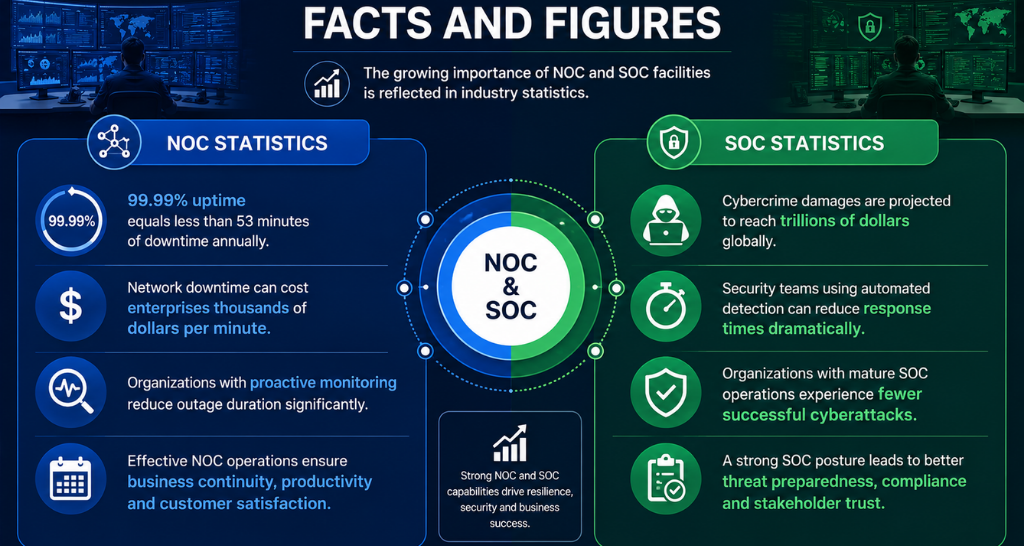
The growing importance of NOC and SOC facilities is reflected in industry statistics.
NOC Statistics
- 99.99% uptime equals less than 53 minutes of downtime annually.
- Network downtime can cost enterprises thousands of dollars per minute.
- Organizations with proactive monitoring reduce outage duration significantly.
SOC Statistics
- Cybercrime damages are projected to reach trillions of dollars globally.
- Security teams using automated detection can reduce response times dramatically.
- Organizations with mature SOC operations experience fewer successful cyberattacks.
These numbers demonstrate why businesses increasingly invest in dedicated NOC and SOC facilities.
How Lightomated Helps Organizations
Lightomated helps organizations transform their control rooms, command centers, and corporate environments with advanced LED video wall solutions. By delivering high-quality displays, seamless visuals, and reliable performance, Lightomated enables better monitoring, collaboration, communication, and decision-making. Our LED video wall solutions are designed to meet the requirements of NOC, SOC, control rooms, meeting spaces, and other professional environments.