Beyond static displays: How LED Video Walls keep museum visitors engaged?
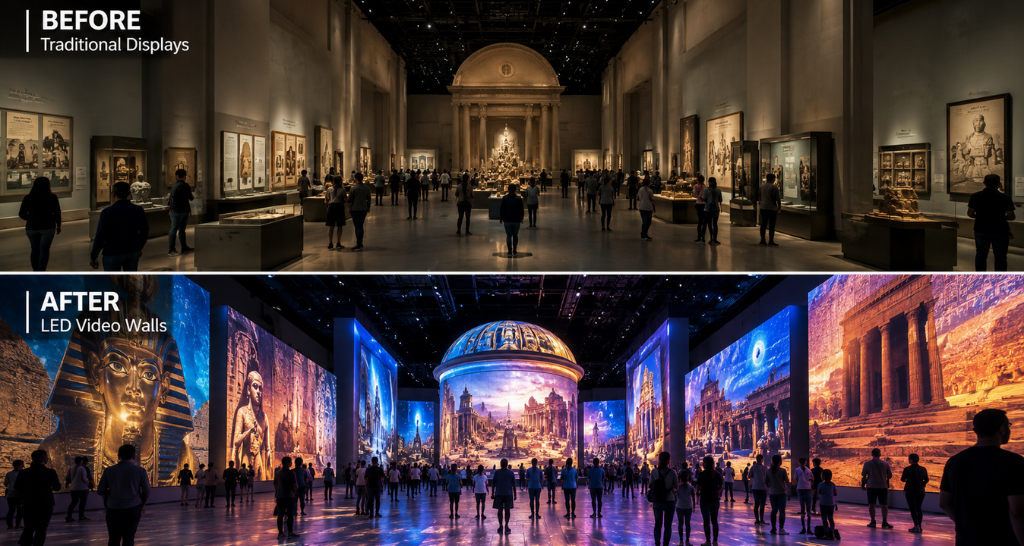
Museums are built around stories, but the way those stories are presented has a direct impact on how visitors experience them. Traditional photographs, printed panels, paintings, and physical exhibits remain important, but static displays can sometimes make it difficult to communicate large scale stories, changing environments, historical events, or complex information in an engaging way with LED Video Walls
Visitors today are accustomed to digital content that is visual, dynamic, and interactive. This has encouraged museums to rethink how information is displayed without taking attention away from the actual exhibits.
This is where LED walls for museums can add a new visual layer to exhibition spaces. Instead of presenting information through a fixed image or screen, a large LED display can create seamless visuals, animations, timelines, maps, reconstructions, and immersive backgrounds that support the story being told.
From static exhibits to dynamic visual experiences with LED Video Walls
A static exhibit usually communicates through a fixed visual or written message. Visitors need to stop, read, observe, and interpret the information themselves. This works well for certain types of collections, but it may not be enough when the subject requires movement, scale, or visual context.
An LED wall in a museum can change the way information is presented. Content can be updated according to an exhibition, event, gallery theme, or visitor journey.
For example, a history museum could use an LED wall to show:
- Historical maps changing across different periods
- Digital reconstructions of ancient locations
- Archival photographs and videos
- Animated timelines
- Large-scale historical events
- Cultural performances and environmental footage
The physical artefact remains the centre of the exhibition, while the LED display provides additional context around it. This combination can make the experience easier to understand without replacing the authenticity of physical collections with LED Video Walls.
Immersive storytelling through LED video walls
Museums often deal with subjects that are difficult to explain using text alone. A historical building may no longer exist. A natural environment may be located thousands of kilometres away. An archaeological site may have changed significantly over time.
Large-format LED displays can help recreate these visual environments.
For instance, an exhibition about ancient civilisation could use a high-resolution LED wall to display a reconstructed city, changing landscapes, or animated architectural elements. A visitor does not simply read about the location they can see its scale, surroundings, and transformation.
This makes LED walls for museums particularly useful for storytelling.
The content can also be designed around the visitor’s movement. A gallery may begin with a wide visual introduction, move into detailed historical information, and then transition into photographs or videos related to individual exhibits
The result is a more connected visual journey rather than a collection of isolated displays.raditional display methods struggle to match modern expectations.
This is where advanced museum display technology starts changing the experience.
Large visuals without visible screen gaps
One of the biggest advantages of LED technology is its ability to create large, continuous display surfaces.
Traditional multi-screen setups can have visible bezels between individual screens. These gaps can interrupt images, maps, videos, and panoramic content and LED Video Walls.
A properly designed LED video wall creates a much more seamless visual surface.
This becomes especially useful in museums where content is designed to extend across an entire wall. A panoramic landscape, historical map, architectural reconstruction, or cinematic sequence can occupy a large viewing area without obvious divisions between panels.
The display size can also be planned according to the gallery rather than being restricted to standard television or monitor dimensions in LED Video Walls.
Content that changes with the exhibition
Museum exhibitions are not always permanent. Temporary exhibitions, travelling collections, cultural events, educational programmes, and special occasions may require different content.
An LED wall for museum exhibitions provides flexibility because digital content can be changed without physically replacing the display hardware and LED Video Walls.
A museum could use the same LED installation for:
- Permanent galleries
- Temporary exhibitions
- Cultural events
- Educational sessions
- Special commemorations
- Promotional announcements
- Visitor information
This reduces the need for multiple display formats across different areas of the museum. the content management system can also allow authorised teams to schedule or update visual content according to the exhibition calendar.
Many institutions now explore museum display solutions that transform static environments into engaging storytelling spaces.
Better visual context around physical artefacts
Digital displays work best when they support the physical collection rather than compete with it.
Consider an archaeological artefact displayed inside a glass case. The object itself may be relatively small, while the story behind it could cover hundreds of years. an LED wall placed nearby could display its excavation location, historical period, original surroundings, restoration process, or related artefacts and LED Video Walls.
This creates a simple relationship:
Physical object → Digital context → Deeper understanding
The visitor can observe the original object while using the digital content to understand where it came from and why it matters.
For educational museums, this approach can be particularly useful for younger visitors who may respond more easily to visual explanations.
Visual engagement across different visitor groups
Museum visitors have different ages, interests, and levels of knowledge.
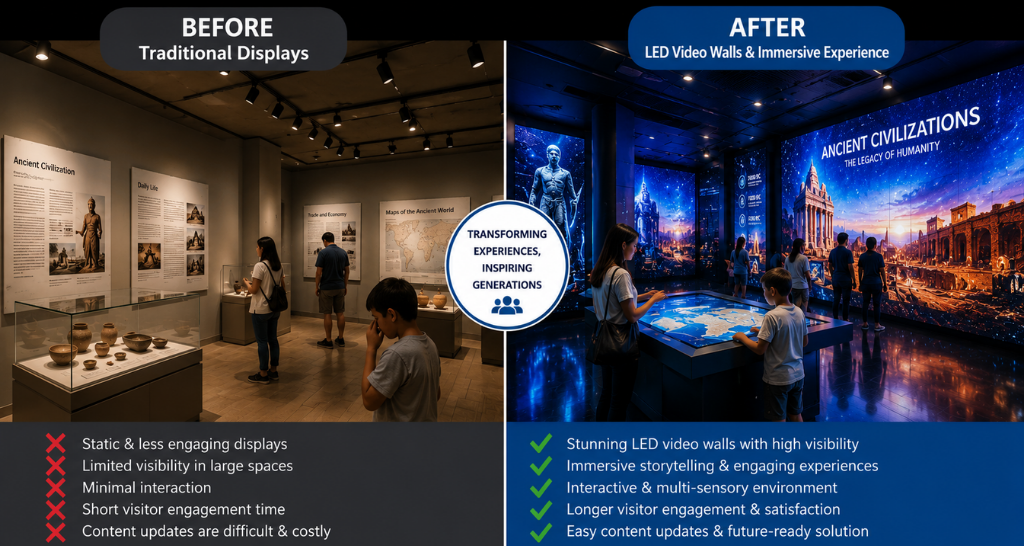
A detailed information panel may be useful for researchers or highly interested visitors, but casual visitors may not spend several minutes reading every section.
LED displays can communicate information through a combination of:
- Video
- Animation
- Photography
- Graphics
- Maps
- Motion content
- Text overlays
- 3D visualisations
This gives museums more ways to communicate the same subject and LED Video Walls
For example, a complex scientific process can be shown through an animation instead of relying entirely on technical text. Similarly, a geographical story can be explained through an animated map.
The objective is not simply to make the gallery more visually attractive. It is to make complex information easier to follow and Audio Visual Integration.
Let’s revisit the same museum. this time visitors enter a redesigned exhibit space. as they walk in, large LED Video Walls introduce the story visually. Historical events unfold through motion graphics. Animated timelines guide visitors naturally. Digital environments surround them. children point toward moving content. students stop to discuss exhibits. families spend more time in each section and LED Video Walls.
People begin taking photos and sharing experiences online. the journey changes completely. the difference is not just appearance. the difference is engagement.
A more flexible museum visitor journey
The placement of digital displays can influence how visitors move through an exhibition and LED Video Walls.
An LED wall near an entrance can introduce the theme of a gallery. Another display can provide deeper context in the middle of the experience, while a final visual installation can summarise the story before visitors move to the next section.
This creates opportunities for museums to design a more structured visitor journey.
For example:
Introduction → Exploration → Context → Immersion → Conclusion
LED technology can support each stage through different content formats. large displays can also act as visual landmarks within bigger museums, helping visitors recognise major galleries or exhibition zones.
Installing an LED video wall inside a museum is not simply a matter of selecting a large screen. the display needs to be planned around the gallery’s viewing distance, ambient lighting, wall dimensions, content requirements, operating hours, and maintenance access.
Pixel pitch is particularly important. A display installed close to visitors generally requires a finer pixel pitch to maintain image clarity. A larger viewing distance may allow a different specification.
Brightness also needs careful control. Excessive brightness can become uncomfortable in dark gallery environments and may distract from physical exhibits.
Other considerations include:
- LED module quality
- Viewing distance
- Brightness control
- Refresh rate
- Colour accuracy
- Content resolution
- Processing and control
- Ventilation
- Front or rear maintenance access
- Power requirements
A museum AV integrator can evaluate these factors before finalising the display specification.
Creating memorable museum experiences with LED displays
The role of technology in museums is not to replace authentic collections. Instead, it can provide additional ways to understand and experience them. LED video walls can bring movement, scale, colour, historical context, and immersive storytelling into spaces that were previously limited to static visual communication.
When carefully integrated with physical exhibits, they can help museums explain complex subjects, refresh temporary exhibitions, support educational programmes, and create stronger visual connections between different parts of a visitor journey LED Video Walls.
The most effective museum display is therefore not necessarily the biggest screen. It is the one that fits the story, space, audience, and purpose of the exhibition.
With the right content strategy and AV design, LED video walls for museums can transform a static visual environment into a more dynamic and flexible storytelling space.aying longer, engaging deeper, and leaving with experiences they remember.