LED Video Wall Controllers Explained: Features, Types, & Key Functions
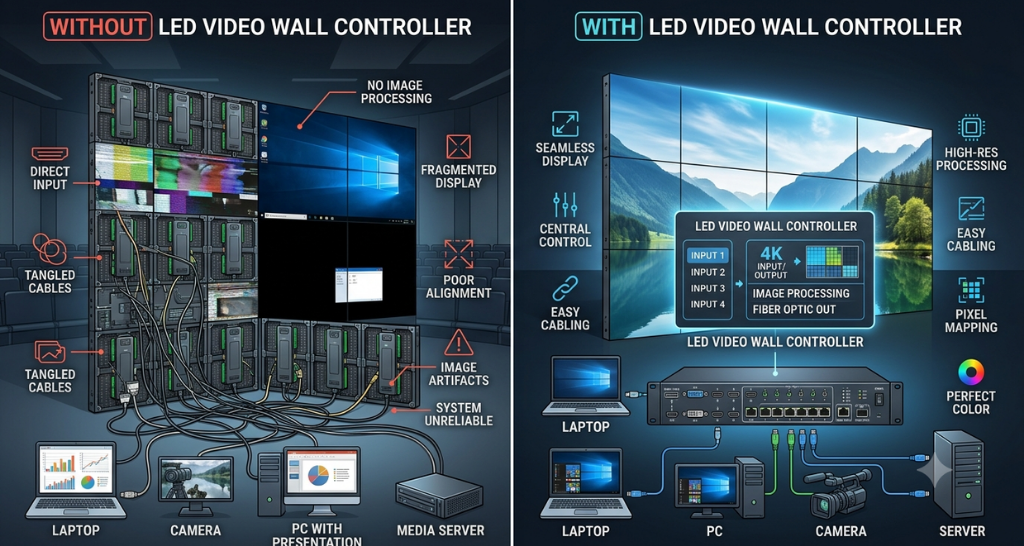
As LED display technology continues to evolve, businesses are investing in high-performance video walls to deliver engaging visual experiences. From corporate boardrooms and retail stores to auditoriums, control rooms, broadcast studios, and entertainment venues, LED video walls have become the preferred display solution. However, behind every seamless display is a powerful LED Video Wall Controller that manages and processes the content displayed on the screen.
An LED Video Wall Controller acts as the brain of an LED display, ensuring every image, video, presentation, and live feed is displayed accurately and without interruptions. Without a controller, individual LED cabinets cannot work together as a single display. Whether you’re installing a small indoor screen or a large commercial video wall, choosing the right LED Video Wall Controller is critical for achieving high-quality visuals.
Modern LED Display Controller technologies support multiple input sources, ultra-high resolutions, real-time image processing, and flexible display configurations. Understanding Video Wall Controller Features and selecting the right LED Video Wall Control System helps businesses maximize display performance while improving operational efficiency.
What is an LED Video Wall Controller?
An LED Video Wall Controller is a hardware device that receives video signals from different sources, processes the content, and distributes it to multiple LED cabinets to create one seamless display. It converts digital input signals into formats that LED modules can understand while maintaining synchronization across the entire screen.
Unlike standard media players, an LED Video Wall Controller performs advanced processing such as image scaling, signal switching, color correction, resolution mapping, and screen synchronization.
A professional LED Display Controller supports multiple input formats, including HDMI, DisplayPort, DVI, SDI, USB, and network-based video signals. These controllers ensure that every LED module displays the correct portion of the image, resulting in a smooth and uninterrupted viewing experience.
Whether you’re installing an Indoor LED Display or a large outdoor digital billboard, selecting the right LED Video Wall Control System is essential for reliable performance.
Why is an LED Video Wall Controller Important?
An LED display is only as good as the controller driving it. Even the highest-quality LED panels cannot deliver exceptional performance without a properly configured LED Video Wall Controller.
Here are the key reasons why it is important:
1. Maintains Image Quality
A professional LED Video Wall Controller ensures images remain sharp, color-accurate, and properly scaled across the entire display.
2. Supports Multiple Input Sources
Modern LED Display Controller devices allow users to switch between laptops, media players, cameras, conferencing systems, and digital signage platforms without interruption.
3. Provides Seamless Synchronization
One of the most important Video Wall Controller Features is synchronizing every LED cabinet so content appears as one continuous image.
4. Improves Display Reliability
A high-quality LED Video Wall Control System minimizes screen tearing, signal delays, and display errors, ensuring smooth performance during critical presentations and live events.
5. Enables Flexible Screen Layouts
An LED Video Wall Controller supports custom display layouts, allowing organizations to create large-format screens, ultra-wide displays, and creative video wall designs.
How Does an LED Video Wall Controller Work?
The working principle of an LED Video Wall Controller involves receiving, processing, and distributing video signals across multiple LED cabinets.
Step 1: Signal Input
Content is received from various devices such as:
- Laptops
- Media servers
- Cameras
- Video conferencing systems
- Digital signage software
- Streaming devices
The LED Display Controller accepts these signals through HDMI, DVI, DisplayPort, SDI, USB, or IP-based connections.
Step 2: Video Processing
The controller processes the incoming signal by performing:
- Resolution scaling
- Frame synchronization
- Color calibration
- Brightness adjustment
- Image enhancement
- Signal conversion
These advanced Video Wall Controller Features ensure content appears clear and properly optimized for the LED display.
Step 3: Screen Mapping
The LED Video Wall Control System maps every pixel to the correct LED cabinet.
For example, if a video wall consists of 24 cabinets, the controller divides the image into 24 synchronized sections before transmitting them.
Step 4: Data Transmission
After processing, the LED Video Wall Controller sends data to receiving cards installed inside each LED cabinet.
These receiving cards distribute image data to individual LED modules.
Step 5: Display Output
Each LED module lights up its assigned pixels, producing one seamless image across the entire display.
Whether using the Vivid Series for premium indoor installations or another display solution, the controller ensures smooth playback with minimal latency.
What an LED Video Wall Controller Does?
A professional LED Video Wall Controller performs multiple functions that improve display quality and system reliability.
It Does
- Processes multiple video inputs
- Synchronizes LED cabinets
- Supports 4K and higher resolutions
- Enables image scaling
- Controls brightness and color settings
- Switches between multiple content sources
- Supports split-screen layouts
- Provides centralized display management
It Doesn’t Do
- Generate content automatically
- Replace LED cabinets or display panels
- Increase internet speed
- Repair damaged LED modules
- Eliminate poor-quality source content
- Replace professional display installation
LED Video Wall Controller vs Video Splitter :
| Feature | LED Video Wall Controller | Traditional Video Splitter |
|---|---|---|
| Image Processing | Advanced | Basic |
| Resolution Scaling | Yes | Limited |
| Color Calibration | Yes | No |
| Multiple Inputs | Yes | Limited |
| Screen Mapping | Automatic | Manual |
| Seamless Display | Yes | No |
| Real-Time Switching | Yes | Limited |
| Large LED Walls | Excellent | Not Recommended |
Compared to a basic splitter, an LED Video Wall Controller offers significantly better image quality, flexibility, and management capabilities.
When integrated with professional Audio Visual Integration solutions, these controllers deliver synchronized audio and video experiences that enhance communication and audience engagement.
Types of LED Video Wall Controllers :
Choosing the right LED Video Wall Controller depends on the display size, application, resolution requirements, and content management needs. Different controllers are designed for different use cases.
1. Synchronous LED Video Wall Controller
A synchronous LED Video Wall Controller displays content in real time from an external source such as a laptop, media server, camera, or PC. These controllers are widely used in conference rooms, auditoriums, command centers, and live events where instant content display is essential.
2. Asynchronous LED Video Wall Controller
An asynchronous LED Display Controller stores media files internally and plays them according to a predefined schedule. These controllers are commonly used for digital signage, retail advertising, transportation hubs, and information displays.
3. All-in-One LED Video Wall Controller
This type combines video processing, signal switching, scaling, and sending functions into a single device. It simplifies installation while reducing equipment requirements.
4. 4K & 8K LED Video Wall Controllers
Modern LED Video Wall Control System solutions support ultra-high-definition content, making them ideal for premium corporate environments, auditoriums, experience centers, and broadcast applications.
Key Components & Technologies :
A professional LED Video Wall Controller consists of several technologies working together to deliver seamless visual performance.
Video Processor
The video processor receives input signals, scales images, adjusts resolutions, and optimizes image quality before sending data to the display.
Sending Cards
Sending cards transmit processed video data from the controller to the receiving cards installed inside LED cabinets.
Receiving Cards
Receiving cards decode incoming signals and distribute image information to individual LED modules for accurate display.
Image Scaling Engine
One of the most valuable Video Wall Controller Features is intelligent image scaling, allowing different input resolutions to fit perfectly on the LED wall without distortion.
Color Calibration Technology
Modern LED Display Controller solutions automatically calibrate brightness, contrast, white balance, and color consistency across the display.
Signal Switching
Professional controllers support multiple input formats, enabling users to switch between laptops, cameras, media players, and conferencing systems instantly.
Screen Management Software
Most advanced LED Video Wall Control System platforms include software for scheduling, monitoring, diagnostics, remote management, and content control.
Benefits of an LED Video Wall Controller :
Investing in a professional LED Video Wall Controller provides long-term operational and visual advantages.
Superior Image Quality
Advanced processing ensures every image is displayed with sharp resolution, vivid colors, and excellent contrast.
Seamless Display Synchronization
One of the key Video Wall Controller Features is synchronized playback across multiple LED cabinets, eliminating visible image breaks or delays.
Flexible Content Management
A modern LED Display Controller supports multiple content sources, making it easy to switch between presentations, videos, live feeds, and digital signage.
Improved Reliability
Professional controllers reduce signal loss, screen tearing, and synchronization issues, ensuring stable performance during continuous operation.
Easy Scalability
As display requirements grow, the LED Video Wall Control System can support additional LED cabinets and higher resolutions without requiring a complete system replacement.
Simplified Operation
Centralized software allows operators to manage multiple displays from a single interface, reducing manual effort and improving efficiency.
Facts & Figures :
The global demand for LED display technology continues to increase across commercial and enterprise applications. High-performance controllers play a significant role in this growth.
- Premium LED displays can deliver an operational lifespan of up to 100,000 hours under recommended conditions.
- Modern LED Video Wall Controller solutions support resolutions ranging from Full HD to 8K, depending on the model.
- Fine-pixel-pitch LED walls can achieve refresh rates exceeding 3,840 Hz, ensuring smooth visuals for live broadcasts and fast-moving content.
- Many enterprise-grade controllers support multiple HDMI, DisplayPort, SDI, DVI, USB, and IP-based inputs for maximum flexibility.
- Advanced LED Display Controller systems include HDR support, low-latency processing, and real-time image enhancement technologies.
These capabilities make professional controllers essential for organizations that rely on high-quality visual communication.
How Lightomated Helps
At Lightomated, we provide complete LED display solutions designed for corporate, retail, education, hospitality, and government environments. Our team helps customers select the right LED Video Wall Controller based on display size, resolution, application, and future expansion requirements.
Whether you’re deploying a fine-pitch indoor display from our Neo Series or a large commercial LED wall, our experts ensure every LED Video Wall Control System is optimized for reliable performance and seamless operation.